Well, hopefully now you’ve gotten the hang of putting some holes in your work. You should have noticed that by purling all the stitches on the reverse side, you give yourself the opportunity to close the holes and create the pattern. Then on the next row you have the option of offsetting those holes either to the right or left and/or continuing them vertically to create the desired effect. Although the main design element in lace knitting is done with the holes (yarn overs), the type of decrease, the direction of them, and where they are placed are integral in the development and aesthetic appeal of the pattern. Today we’re going to introduce two new elements to you in lace knitting – the double decrease and the right slant decrease. You will see from the key in today’s chart pattern that the double decrease looks like a bird’s footprint and the right slant decrease is just a slanted line going from the bottom left hand corner of the square to the top right hand corner. I’ll take this moment to note that there are no set standards for symbols on a chart (yet) and it’s important that you read the key to interpret the symbols and what they mean. The chart I use are produced using a program created by Jacquie that can be found at her blog here. There is a link under Knitting Resources on the left hand side. Thanks for putting this up for everyone’s use Jacquie.
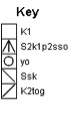
As for the new elements, they are the following:
K2tog – Right Slant Decrease – Knit the next two stitches together onto the right needle. Place your right needle into the next two stitches on your left needle and knit them together at the same time.
S2k1p2sso – Double Decrease (3 stitches to 1) – Slip the next two stitches together on the left needle knit wise onto the right needle. Knit the next stitch on the left needle. Pass the two slipped stitches over the stitch just knit. This is not the only way to do a double decrease but it is the one we are going to use in this pattern.
Here is the chart for today’s design. It is a little more complex than yesterday’s, but if you made it through that one you shouldn’t have a problem with it. Just remember to keep track of which row you’re on and try to complete a full row always. We’ll go through other ways of keeping track of rows and stitches as we start to work on larger and more complex patterns.
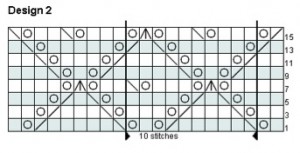
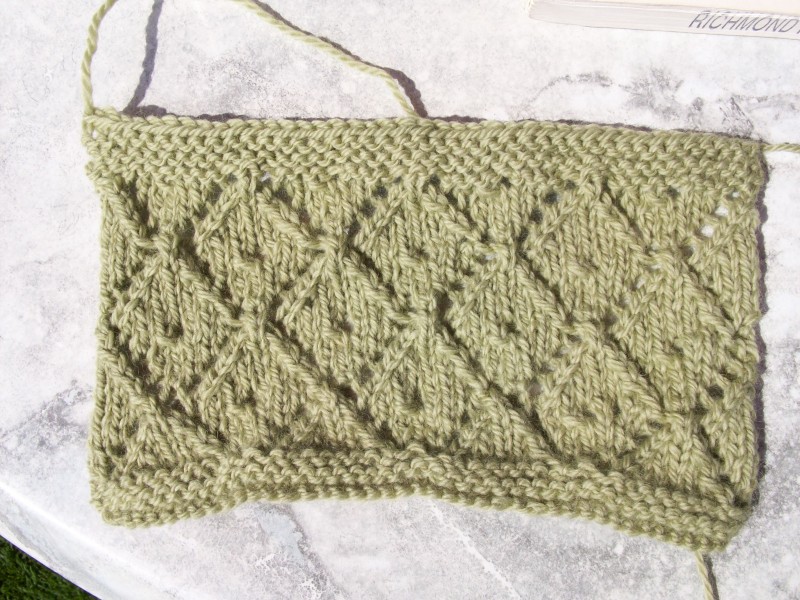
This design is a 10 stitch and 16 row repeat pattern with a total of 11 extra stitches, 2 on the right and 9 on the left as shown in the chart above. Don’t let this throw you for a loop though, it is necessary to balance the pattern. Again, you will want to add 2 stitches on top of everything as selvedge stitches. Also, cast on your desired number of stitches (I recommend 3 repeats of the pattern) and then work four rows of garter stitch. Use the 5th row as Row 1 of the pattern. When you ave finished your row repeats (I recommend 2 – 3), repeat the 4 rows of garter border before casting off. Here is a picture of what it looks like before being blocked. Tomorrow I will put up pictures of both designs after they have been blocked and we will discuss the benefits of blocking and lace.
Good luck with this design.
Hugzzz 😎