
Okay, now that we have a basic idea of what Lace Knitting is about and we’ve selected our tools, it’s time to actually start something. We haven’t discussed casting on and off yet and we won’t need it right away. For the first few swatches we do, cast on the desired number of stitches with any method of your choice and then knit 4 rows of garter stitch. The firth row will be the start of the pattern (Row 1). You will knit 4 rows of garter stitch after your last row (you can do as many repeats of the pattern rows as you like) and then cast off.
Now we’re just going to get your feet wet with some simple increases and decreases that are commonly used in LK. There are two patterns that we are going to use to make some swatches. The first is a simple left slanting pattern where the holes are matched by a decrease right after their creation. If you remember from the previous post, the holes are created with yarn overs and because we want to keep the size the same, they must be matched with corresponding decreases. The decrease we are going to use for this is the SSK decrease to give us the left slant. For the SSK decrease you slip one stitch, then the next to the right needle. Then you place the left needle in the front of those 2 stitches and knit them together. Another method (somewhat simpler as well) is to take the right needle and go through the back of the next 2 stitches on your left needle. Knit them together. If you wanted your pattern to slant to the right you could use a K2tog decrease in place of the SSK. The pattern and chart use the SSK decrease however so the pictorial representation from the chart shows the lean going to the left. Here is the pattern for the first design in chart form.

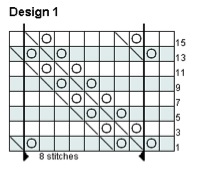
This first design is an 8 stitch repeat with 3 extra stitches added on – 2 at the right and one at the left. You should also add 2 more selvedge stitches. Since this is a swatch, I recommend slipping the first stitch and knitting the last on all rows. Remember that the selvedge edge stitch is not part of the pattern. The other 3 extra stitches are however but they are not part of the repeat. So if you wanted to do 5 repeats of the pattern you would need 5×8=40 + 3 + 2 stitches for a total of 45 stitches. The reverse side rows are purl all stitches. Try this pattern and see how you fare. Here is a picture of the pattern knitted up before blocking.
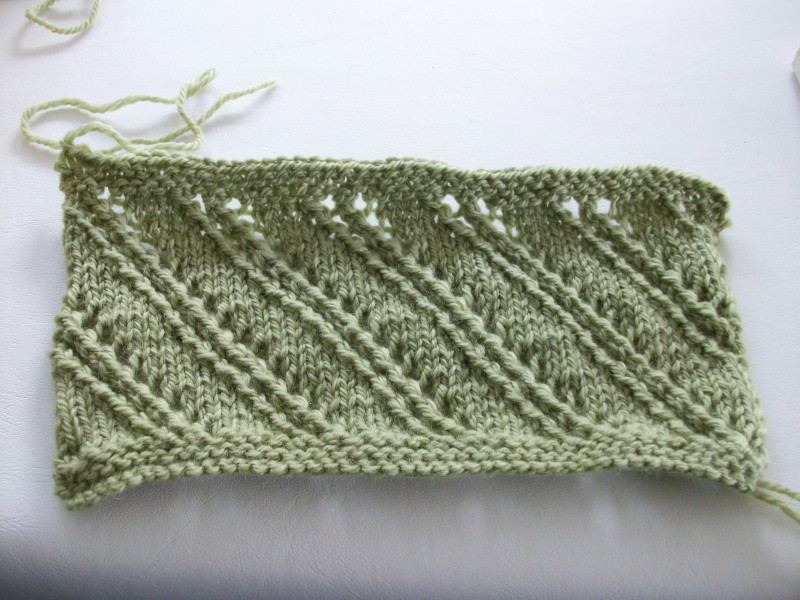
Give it a try and see how you fare. Tomorrow we’ll look at a pattern that has right and left slanting decreases.
Hugzzz 😎