When it comes to food, most of agree that Organic food tastes better than non-organic. Personally I find it interesting and a bit sad that we actually have to label food as Organic. I mean, it’s all coming from the ground, right? Isn’t that what organic means? Okay, time to back up … apparently the definition isn’t that simple. According to Wikipedia, organic (food) is food that is heavily regulated in terms of the use of pesticides, insecticides, and herbicides. Generally, such chemicals are prohibited and/or saved as a last resort. Certain non-organic fertilizer may still be used so it is important to know the standards of the region where the food is coming from. If livestock are involved, they must be rared without the use of routine antibiotics, growth hormones, and generally fed a healthy diet. some countries also prohibit the use of nanotechnology in the production of organic food. Wow, when did eating become so complicated? Up until the last century, agriculture was organic worldwide!
Hey wait, this is a knitting blog! so what does this whole organic debate mean for us? Well, if you’ve been knitting for a while, you’ll have noticed the introduction of organic yarns on the market. When talking about organic fibers, Wiki says they are materials that are raised or grown without the use of pesticides, herbicides, or other chemicals. An interesting fact:
- Cotton covers 2.5% of the world’s cultivated land yet uses 16% of the world’s insecticides, more than any other single major crop. It can take almost a 1/3 pound of synthetic fertilizers to grow one pound of raw cotton in the US, and it takes just under one pound of raw cotton to make one t-shirt.
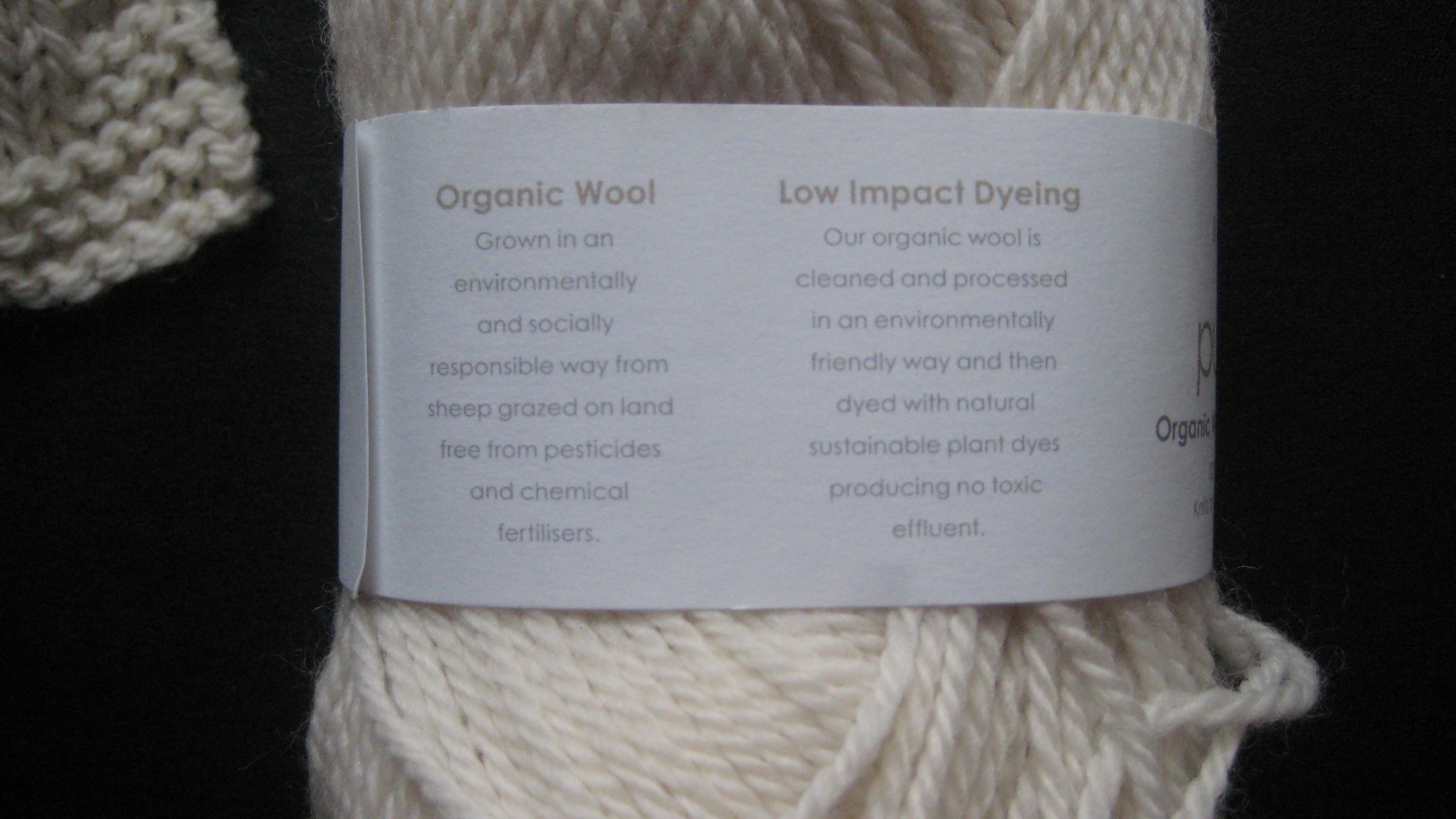
The Rowan Purelife label telling of the processing of the wool.
I’ll have to do more research and do a post to see the conversion rate of raw cotton to yards or grams of actual yarn. When talking fiber though, the organic debate goes into the processing and dyeing of the material as well. It wouldn’t be very smart to have an organic material then use an acid dye on it, would it. While I’ll blog about dyeing in the future, it’s a process that produces lighter colors when done organically (generally speaking). So there you have it in a nutshell. I know that when I’m eating, the debate is simple. If organic food is available to me at a reasonable price, I’ll buy it (except for bananas which don’t seem to be the same to me – funny, as I love bananas). I can see the difference immediately as t is very easy to measure qualitatively.
What about organic fiber? Aside from helping the environment, what are the benefits of using organic fiber? Does it feel better? Smell better? Taste? Oh wait, we’re not talking food. Recently I got my hands on some organic wool and thought I’d give it a try. Now, in comparing this with conventional wool, I would have to find a similar product and see the difference. I am going to use a generic wool from KnitPicks to make my comparisons.
- Price: While this is not the first determinant for most, it is usually one of the most important. The organic retails for about $12/50g ball @ 125m in DK weight. The generic is about $2.79 for the same product although there are 15m less on the generic.
- Color: As stated before, chemical dyes are not used in producing organic fiber, so the range is very limited. The KP wool however, has a vast color range, as it is processed chemically.
These two comparisons are very quantitative. There are however, a number of variables that are not so easily measured and are a matter of opinion. Feel, comfort, ease of use to name a few. Personally, after knitting a test swatch with the organic wool, I have to say I was impressed by the softness of it and the way it slid through my fingers as I knit with it. I would love to find this in a worsted or true aran weight to make myself a sweater. Obviously, this is just scratching the surface of the organic debate. I would love to hear your opinions and experiences using organic fibers. Having said that, let me also say that I try to reduce my carbon footprint whenever and wherever possible. I realize that the cost difference in organic and non-organic fiber won’t always be as drastic as it was in this comparison, but I am certain for the next few years at least it will favor non-organic fibers. Please keep this in consideration when making your comments and don’t send me hate mail about making eco-friendly options looking so bad. It is what it is and for not it is a classic catch 22. Until more people start making eco-friendly choices, the price will be higher, but until the price drops, more people won’t make those choices. Manufacturers of eco-friendly products have to find a way to raise awareness to convert people and increase demand and supply. Let the debate rage on!
Hugzzz 😎