All right then, hopefully by now you’ve decided on your yarn of choice for the knit along. Hopefully you’ve also done a swatch and have the gauge and know what needles you’re going to be using. Now it’s just a matter of knitting yourself a beautiful new fitted top. So before we get started, let’s do a very quick checklist …
- Spring/Summer 2011 Issue of Vogue Knitting International
- Appropriate yarn for the Fitted Top (pattern # 17 shown on page 60 with pattern on page 90)
- Needles required to attain gauge (20 stitches x 28 rows over 4″ x 4″ in stocking stitch)
- stitch holders
- bra cup lining
- glass of wine
Okay, now we’re set to get going. Now I’m not certain about the exact process you use when knitting something from a pattern, so I will go through this one with you in the manner that I do it. I know you’re not going to believe this (yes Anne, this is true), but the first thing I do is read through the pattern. It’s an important step not just to familiarize yourself with the pattern, but to make sure there aren’t any surprises along the way. In this pattern, when you first read through it, there are a couple of things that show up. The first thing is the construction of the garment. You will be making two bra cups first. After that, you then make the front of the top, then the back. The back is where there is a bit of difficulty, but we’ll be able to get through it. After that, it’s just a matter of finishing. During the finishing you will need to sew a lining into the bra cups. They suggest an old t-shirt or piece of cotton lining. I would recommend a good quality piece of cotton that best matches the color of your yarn. If you have a sewing machine, great, but if not you will be able to do this by hand as it is small enough. So this knit-a-long will give you a bit of a lesson in finishing if you haven’t done it before.
Another thing that I notice is that there are no selvedge stitches. I think this is very important to add, as there are portions of the front that are done in garter stitch. Adding selvedge stitches now will make the finishing easier later. I would suggest a stocking stitch selvedge, so you can do an invisible seam later. This means that you will be adding two stitches to each side of the pattern and the bra cups, and knitting these stitches on the right side and purling them on the wrong or reverse side. If you’re unfamiliar with the mattress stitch don’t worry, we’ll cover it when we’re doing the finishing. For now, just trust me and add two stitches to whichever pattern size you’re doing. As they are selvedge stitches, don’t include them in your pattern count. On the right side, knit these stitches, and on the wrong side, purl them.
Okay, so let’s get started. Oh, one other thing. You might want to go through the instructions and highlight the instructions for the size you are doing. I am doing the small size, so in my case I need to cast on 48 stitches + 2 (selvedge stitches) for 50 in total. I use the long tail cast on method over 2 needles. I find this works best for the first row of knitting. Once you have cast on your stitches, remove the second needle and start your knitting. You have to be diligent on the first row in pulling the stitches a little tighter.
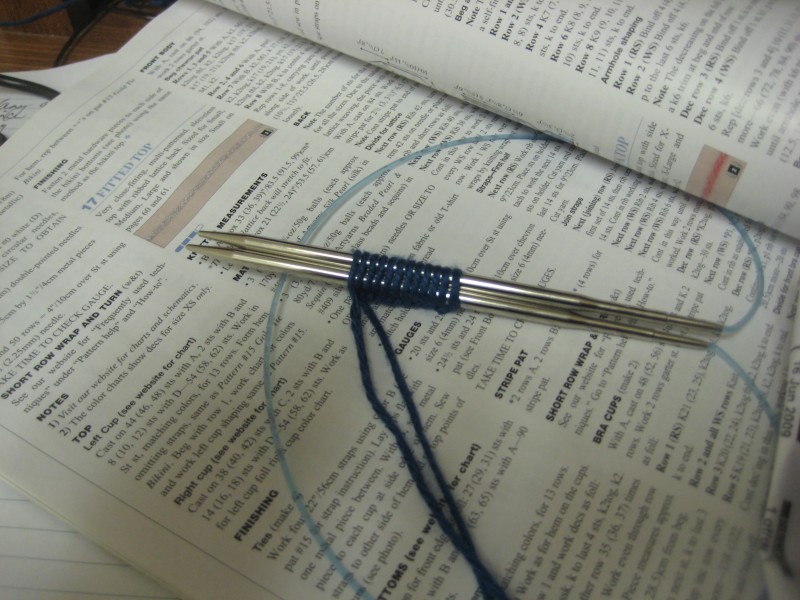
You will also notice that I am using circular needles. For portable projects, this is my preference. There are also some very neat advantages to using circular needles. One of them is that when using the two needles for the cast on I can simply pull on the nylon to remover the “second” needle. So now you’ve cast on the first bra cup and need only follow the instructions in order to complete it. The instructions are pretty straight forward and it uses a combination of increasing and decreasing to shape the cups. You need to make two cups. They will look like the one in the picture below.
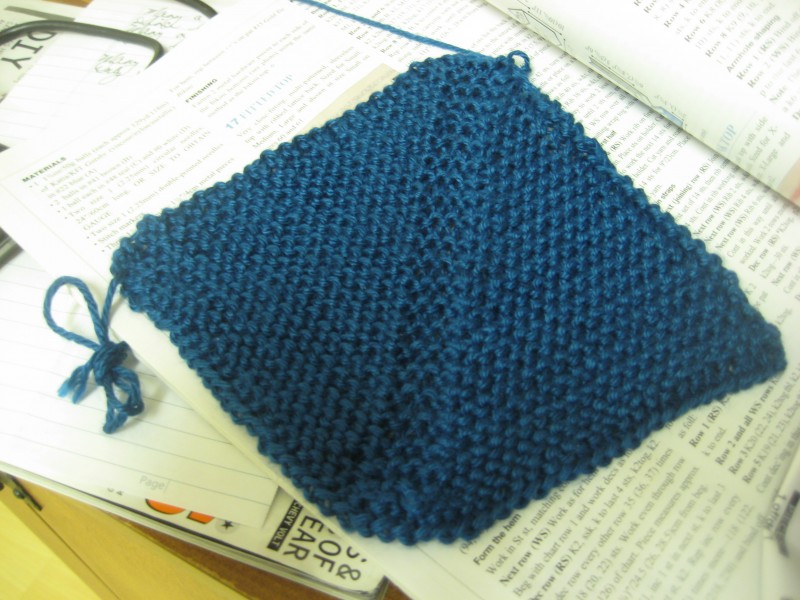
Okay, so make two of these and let me know if you have any problems. On Sunday we’ll go to step 2.
Hugzzz 😎