Before we can actually start producing stunning lace knitting, we have to make sure we have the right tools – just like with any other art or trade. When it comes to lace, there are two things that have the greatest impact on the final product – yarn and needles. We will go over both of them but today we will focus on just the needles. We have already decided that we will do the first few swatches in a DK weight yarn, the specs of which I told you about in the previous post.
Okay, now about the needles. Needles are a funny thing, because there are so many different kinds that do the same thing that they are really a personal thing. Everyone has their favorites and will probably swear by them. For me it depends on what I’m working on and where. When looking at straights, double pointed, or circulars we have to think about the size of the finished object. A lot of lace projects are circular or triangular shaped and in the 5′ range when finished. There can literally be a mind boggling number of stitches on your needle either at the beginning or half-way through your project. While you can use the longer double pointed needles for these projects, it is usually more convenient to use circulars as they come in varying lengths. Also, with the emergence of so many varieties of interchangeable circulars, you can vary the length of the circular as the project grows. One of the most important aspects of circulars (interchangeable or not) is the join between the nylon and the needle. Since you may eventually be working with yarn that is extremely thin (1300+ yards to 50g), you want to make sure that there is a very smooth join there so the yarn won’t get snagged. If this happens you WILL cry – then curse, then sob, then frog, and knit again. You can avoid this process by making sure the join is smooth.
The material the circular is made of and it’s coating are also extremely important. Nickel plated needles seem to be the quickest (IMHO) while the plastic are the slowest. Bamboo falls in the middle somewhere and you can sort out the rest with a little experimentation. With lace you want something that allows you to work at a comfortable speed for your particular ability. You don’t want something that is so fast that you’re dropping stitches left and right, but you also don’t want something that slows you so much that you can only do a row an hour. This leads to hair pulling – check out my picture! The coating on the needles will affect the speed at which you knit as well. I love Crystal Palace bamboo needles as they have a coating on them that make them almost as fast as my Addis. A natural unfinished bamboo is great when I’m knitting with rayon or silk or any other slippery yarn, but not so much when using wool, alpaca, or mohair as they seem to stick. I don’t use plastic needle much at all anymore. They were what I bought originally when I was first learning to knit. Just like yarn though, you find out that quality in materials and workmanship makes a huge difference not only in the finished project but in your enjoyment of it. If they are all you have I suggest you save your pennies and splurge on a higher quality needle. If you take care of it they will last you through more projects than you’d imagine.
The last factors that we’ll consider about needles are the points and the size. You’ve probably noticed that as needles get bigger the points tend to get blunter. Some needles though have a blunt end through all the sizes, while some are pointed and others somewhere in the middle. Once you get used to doing lace, you’ll tend to use finer yarns though and for that you need smaller needles and sharper points. How small the needles you use are again a personal thing as lace rarely requires an exact gauge. As a matter of fact, I rarely do a swatch for tension – I do it to see how that pattern will look with that particular needle size. Sometimes I need to go smaller and sometimes bigger, but you never know until you swatch AND block it. Since I am a loose knitter, I always go down a few sizes anyway, but with lace even more than the recommended size given in the pattern. As for the points, well I like them sharp – always. You may think that this will strand your yarn, but once you get going it’s actually the opposite. The sharper points allow you to pick your yarn (I knit using the continental method 95% of the time) quite quickly without stabbing it. As a matter of fact I have more “accidents” with blunt needles and fine yarn. It’s a lot like cooking, the sharper your knife, the fewer cuts you actually get!
Here is a picture of 6 different needles and their particular characteristics.
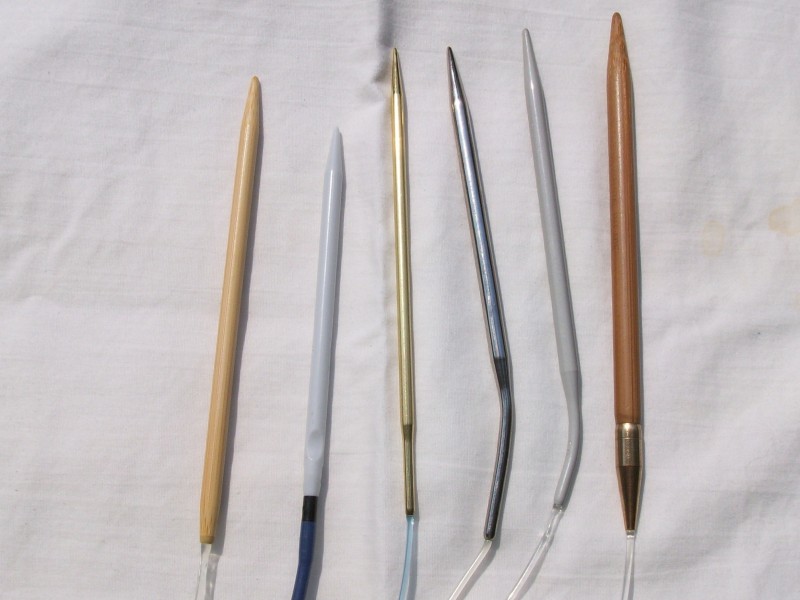
Going from L to R here are the actual needles (all circular):
- Clover Bamboo 5mm 29″ – This is an uncoated bamboo needle wit a relatively blunt tip. The join is a bit problematic as the nylon is flattened just before it reaches the bamboo (not sure why) and smaller stitches sometimes need to be manually manipulated over it.
- Denise Interchangeable 5mm – This a plastic interchangeable needle with a surprisingly very smooth join. The nylon is also of substantial size so it holds the stitches quite well without too much stretching that can sometimes happen with circulars with smaller nylon.
- Addi Turbo Lace 3.5mm 24″ – The Addis now come in a needle specifically made for lace work. The coating is not as fast as with regular Addis and the point is noticeably sharper. The join is quite smooth and the taper well graduated. I plan to try these out for this project as I have not used the lace ones before.
- Inox Nickel Plated 5mm 24″ – Until I used the Addis these were the fastest needles I had used. The join on this needle doesn’t look like it would work well as the nylon is a little smaller than the needle and there is no taper but the coating on it allows them to slide on it quite quickly. The drawback of this needle though is the bend in the needle in the shorter lengths (not sure why it’s there).
- Prym Coated Aluminum 5mm 24″ – Who doesn’t have a pair of these circulars? Again, they were the first circulars I bought but they are a very good all round needle. The coating is right in the middle for speed but unfortunately they have a slight bend in the needle like the Inox and the flattened nylon like the Clover. The point is also right in the middle – not blunt and not sharp.
- Crystal Palace Coated Bamboo 7mm 29″ – The coating on these needles make them remarkably fast (especially for a bamboo needle) and the join has an ingenious swivel that allows the needle to rotate independently from the nylon. This prevents twisting of your work which is a huge annoyance negator. There is also a brass colored metal cap over the needle allowing for a smoother transition of stitches onto the needle. Unfortunately the point is very blunt – the bluntest of all those pictured here.
So there you have a few options. Like I said earlier though, needles are a personal thing. You have to consider the points discussed here and then choose one that you like after taking all the factors into consideration. If you check with your LYS they may have opened needles that you can try before you buy if you don’t have something suitable for lace. Good luck and we’ll get started in the next post!
Hugzzz 😎