Okay, I never went anywhere, yet, but with packing to move, the Star Trek convention, my 2 weekly knitting groups, AND the World Cup, it’s been a very busy week. Somewhere in there I managed to design a shrug pattern using the Barrington Braid (and others) as well and am now knitting that. I will have pictures and pattern information as soon as I finish it and have Anne do a test knit for me. I think you will like it though as there will also be a Bolero option and both pattern will be included in the one. So that’s a brief update of what’s been going on with me. As for all of you, I’ve only received one comment regarding the World Cup knitting project. There’s only 10 more days remaining. Is your favorite team still in? Brazil is still in there and I plan to make something using their colors by the end of it. In other news, I also haven’t received any emails with pictures from the sock KAL we just finished. I know there are a few of you out there who made at least one pair of socks. Send in those pictures and you may win a really cool prize. Antoinette, I’ll even ship it to France as I know you’ve made a pair.
Today I would like to highlight of a friend of mine – Dorota. I have mentioned her in a previous post, but you might have missed it so I would like to revisit that. The reason for the highlight is because she has perfected one aspects of braids that I absolutely love – the starting and stopping of strands. If you’ve ever looked at Elsebeth Lavold’s work, or Alice Starmore, or Dorota’s (Devorgilla on Ravelry), you’ve probably been captivated with the way the strands seem to pop out of nowhere, go along for awhile, then disappear back into nothingness just as quickly. The techniques used to do this vary, but the concept is the same. Basically you’ve got a strand and where it needs to stop, you do a decrease and then change the knit stitch to a purl stitch. In general, you’re decreasing about half your stitches. It’s necessary to decrease as if you remember, the gauge changes from your cable gauge to reverse stocking stitch. Similarly, when you’re starting a strand where there used to be a reverse stocking stitch background, you need to do an increase (or two) before changing those stitches to regular stocking stitch (your future strands). By practicing this technique, you can then create your own intricate (or not) weaves and braids almost anywhere you like. I personally like the effect it gives from the tapering of the strands.
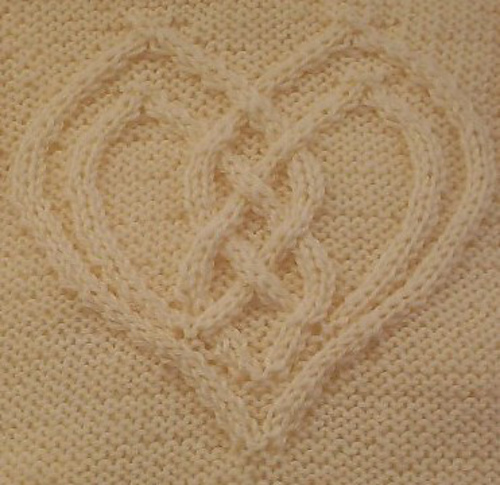
Mother's Love Knot by Devorgilla
Once you’ve got the hang of that, you can go to this website that shows you how to make Celtic knots. Pay particular attention to the modifications of the basic knot. You’ll realize that they’re the same stops and starts we were just talking about above. With a little practice you should be able to come up with the knitting representation of those same knots. Try drawing them out first, then use the grid as a knitting chart, following the principles for reading a knitting chart. The only limitations to what you can make are those in your own mind. If you don’t believe me, look at the motifs on Dorota’s Ravelry page. If you’d rather not have to come up with them yourself, you can purchase the patterns for the ones she’s come up with. And you can always do both.
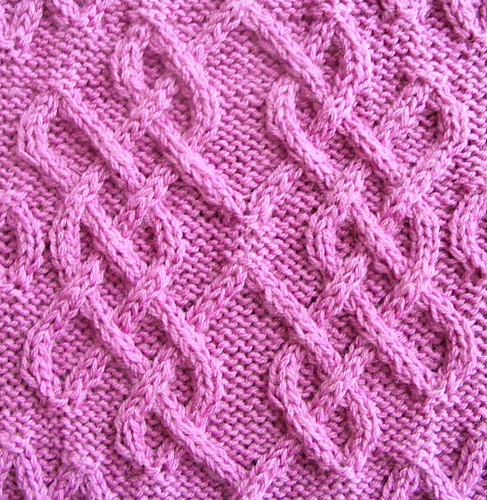
Celtic Motif by Devorgilla
There are many more motifs (she has 60 designs currently) on Dorota’s Ravelry page and all are available for purchase.
Hugzzz 😎