Well, I hope by now everybody that has participated in the very first Socks KAl has finished their first pair. If you haven’t, don’t worry, finish them at your own pace (see yesterday’s post). You now have all the information you need to create socks on your own without a pattern. All you need to do is have your yarn and needles so you can figure out your gauge and make a few simple calculations. I mentioned at the start of the KAL that we would do other socks as well, and we will. But right now, I want to review what we have learned and give you some information for your next pair. In a few weeks (this will give you a chance to make another pair like the one you just did), we’ll do another sock KAL but this time starting from the toe and working to the top of the cuff!
Okay, now that you’ve made it through the first pair of socks, let’s look at a few tips and alternatives to the basic sock worked from the cuff down.
Yarn – You can make socks with any kind of yarn you can knit with, but obviously some are better than other for certain reasons. Sock yarn tends to be in the range of about 7 stitches to the inch. This is a fairly thin yarn (for now we’ll say about 18 wraps per inch but we’ll talk about that in another post). Sock yarn is also commonly referred to as fingering weight yarn. As I said before however, you can use any yarn you like. The thinner yarns are better if you are wearing shoes, but it’s great to have a thick pair of socks for lounging around the house in as well. You might want to use a worsted or chunky weight yarn for that. You’ll also finish the socks a little quicker and thicker yarns are easier to learn on.
- Composition – yarn can be further broken down into sub categories, the first of those being composition. For the KAL I told you NOT to use a purely natural fiber (pure wool, alpaca, cotton, etc) but didn’t get into the reason why. Natural fibers will felt from agitation and will develop holes quite readily where there is the most friction (heels and toes). In order to combat this, sock yarn usually has about 15% – 25% nylon spun into it. Nowadays the nylon is being substituted with bamboo, soy, and other fibers or by using super wash wool entirely. You can use a natural fiber for the cuff, leg, sole and instep and then knit in a nylon in the heel and toes section of the sock as well.
- Color – needless to say, there is no limit on the colors of sock yarn. You have solids, variegated, and now even self patterning yarn in stripes and patterns. There used to be a time where you would have to manually change colors to get either stripes or patterns in your socks, but now self patterning yarn is available that has been specifically dyed to do this for you. All you have to do is knit your socks in stocking stitch as you normally would and the pattern becomes evident as you go along!
- Thickness – as stated earlier, the thickness of the yarn for your socks depends on their function and your preference. Regardless of the yarn you use though, it is a good idea to knit your socks on the smallest needle the particular yarn will accommodate or look good on. Socks last longer and fit better when knit a little tighter.
- Quantity – for foot sizes up to about a men’s 10, usually 100g of regular sock yarn is adequate for 1 pair of socks. Of course, if you want longer socks or put a lot of textured patterning in them you will need more yarn. Unfortunately for me, I’m a size 12 and find that in a DK weight yarn I need about 130g of yarn, and in a regular sock yarn I need about 110g. Ughhhh.
Techniques – There are numerous techniques for knitting socks, and some people find one they like and use that exclusively. Others will use them all depending on their mood or the pattern. We have done a cuff down in the KAL, and in a few weeks we will reverse it and do a toe up. While doing the sock itself, there are techniques inside techniques. You can work both sock at the same time but separately as we just did, or you can do them at the same time on one circular needle (we’ll cover that in the future as well). You can use 1, or 2 circular needles or double pointed needles. The great thing is it’s up to you and whichever way you feel most comfortable with. All the above mentioned techniques will give you a sock.
Variations – In the socks we just made we used a slip stitch heel, gussets, and a wedge toe. Well, you can change all three of those features (and we will) to customize the socks you make. Most patterns take the different looks of each of these features into consideration before deciding on particulars. Obviously, you can also change the patterning inside the socks as well. We worked with ribbed and stocking stitch, but you can do anything you like for your particular desire of expression. There are literally thousands of sock patterns online and hundreds of bloggers that have socks as their specialty. Finding a pattern you like or can modify is relatively easy – deciding on one is another matter!
So now that you know a little more about socks, it’s time for me to mention the next contest – and yes, it’s sock related. If you participated in the KAL you’re already way ahead. Send me a picture of the socks you made during the KAL. I will randomly select a pair (I will probably get somebody else to do it) and that person will win a skein or 2 balls of sock yarn and a pair of 40″ 2.5mm Addi Turbo circular knitting needles. If you didn’t make a pair, you have 1 week to do so, or to finish the pair you were working on. I am trusting in your honor code to only submit socks you have made, and within the time frame we are talking about (from the start of the sock KAL to one week from today). Also, if you are a sock specialist and/or have made more than 5 pairs before this, sorry, but you are not eligible for this contest. I will have something else in the future for all of you. This is very important – all entries need to be submitted by EMAIL to mrhugzzz@gmail.com. Please include your name and attach the picture in any format you wish. The draw will be entirely random and will not be based on the work whatsoever!
In the meantime, here is a picture of a pair of socks I have just completed using self patterning yarn – in this case Regia 4-ply. 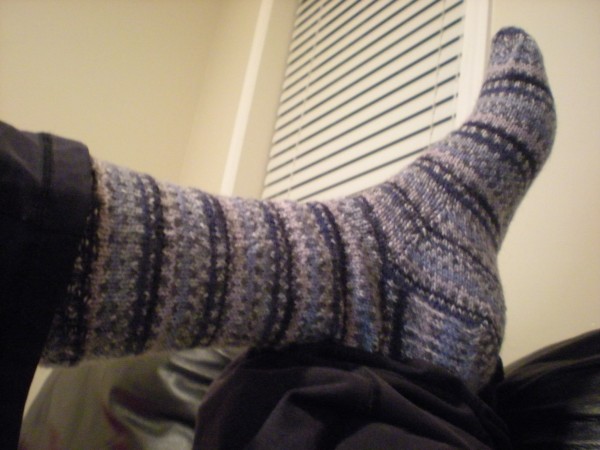
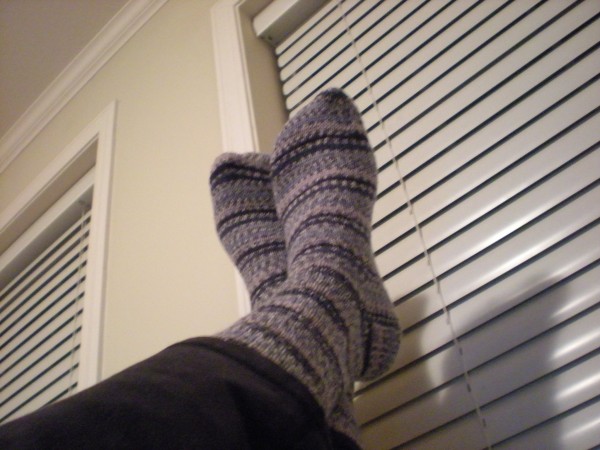
This is a good way to show how you can get a fair aisle and/or stripe pattern by knitting in stocking stitch. The great thing is that your friends won’t be the wiser and you’ll rake in the compliments! You can try using a yarn like this for your next pair of socks, now that you know how to make them. Or maybe you’ll take a basic pattern and add cables. Whatever you decide to do, have fun with them, and try something different you didn’t do in the first pair. I’d love to see what you come up with. We’ll do another sock KAL in a few weeks, starting from the toe and working up to the cuff!
Hugzzz 😎