Any good piece of knitted fabric has to have a good edge. Whether it be knitted or crocheted, it the edge of the piece doesn’t look good, it doesn’t matter how good the main work is. Now that you know how to make a cabled braid any size you want (if you got the ebook that is), you might want to take a look at what to do on the outside of one of the larger braids. Actually, it doesn’t even have to be one of the larger ones. If you are only making a scarf, say, you might still want to have a different texture pattern on the edge to highlight what’s in the middle. A good edge in knitting should be something similar to the main focus, but not overpowering, as to detract from it. When working with braids, a smaller braid makes perfect sense. So for this, I have worked out a few edges using the 4-strand braid that I think would look good on the edge of a blanket. I’m actually helping a friend design an heirloom baby blanket using the Malcolm Matrix as the centerpiece.
I’m thinking that for a blanket, the centerpiece should account for about 50% – 60% of the overall width of the blanket itself. This is not writ in stone, and can vary a bit either way, although if it is much smaller, it wouldn’t look as good. Given this, you would want the rest of the pattern to account for 40% – 50% of the blanket. Since you also want the blanket to lay flat, you’ll need to add a few stitches on either side to allow for a flat stitch if your edge itself isn’t flat. If your edge isn’t flat, you will have to add more stitches as the width of your edge increases to make it so. I guess this really makes the edge an inner border. So anyway, as for the braided edges, I have charted out a few using the 4-strand braid as a basic template. I played around with changing the frequency of the row repeats, going from 12 to 8 and back again. I also experimented with making it wider than just one panel, and having a double strand running between two panels that would weave into and then out of the 2 panels. Lastly, I did a double strand on the outside of one panel, and wove it into and out of the braid as in the other sample. I guess it’s just best to show you what I mean. Here are the charts showing a few options of what you can do with the braids.
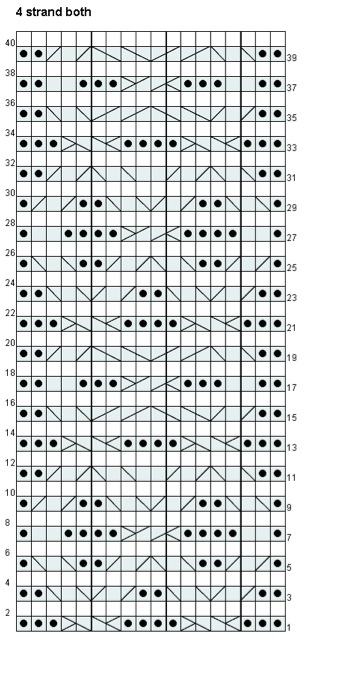
Example 1
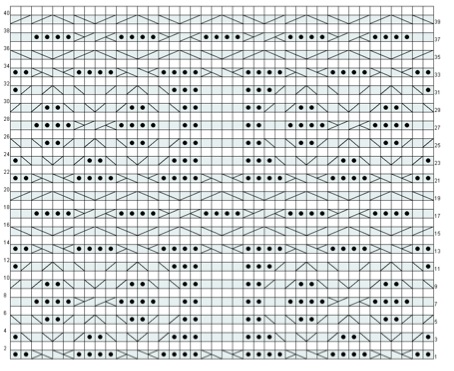
Example 2
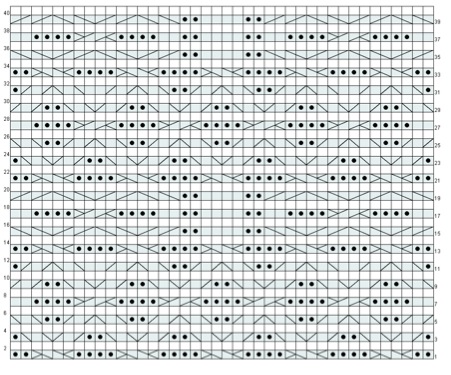
Example 3
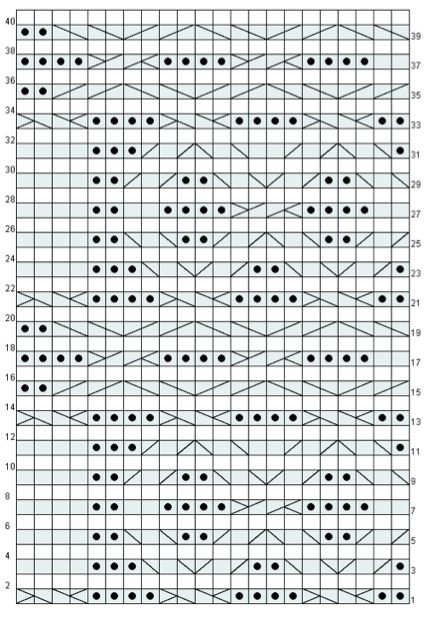
Example 4
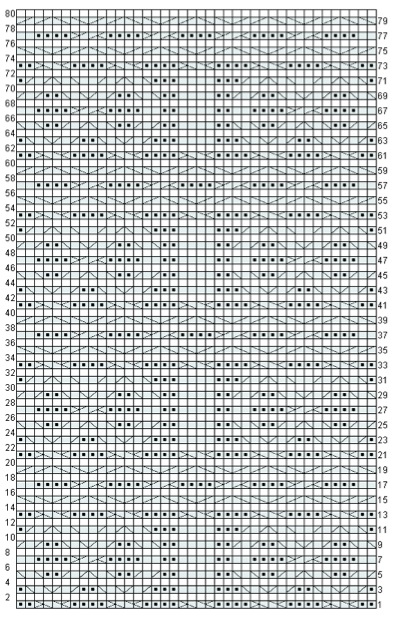
Example 5
Example 1 – This is the 4-strand braid, single panel, alternating between a 12 row and 8 row repeat. I have shown 2 repeats of the pattern to give a better effect. You don’t need to know how to read the chart to see how the cables will entwine.
Example 2 – The same as example 1, except there are 2 panels of the 4-strand braid, and I have put in a double strand in between them that links into the panels on the 8 row repeats.
Example 3 – Same as example 2, but now the double strand in the middle links into the 4-strand braid on the 12 row repeats. If you’re using either of these examples (2 or 3) for edges, you would have to have a fairly large center braid so as to not overpower the piece. Maybe for an adult sized blanket? If the blanket is smaller, you could reduce the 4-strand braid to a 2-strand traveling cable – or open cable. There’s a pattern in the ebook here.
Example 4 – Now i have taken the example 1 and put a double strand braid on one side. This could be a left edge and I would reverse it for the right edge on the other side.
Example 5 – This is just example 2 doubled (80 rows) so you could see the pattern a little better. This could be a centerpiece itself.
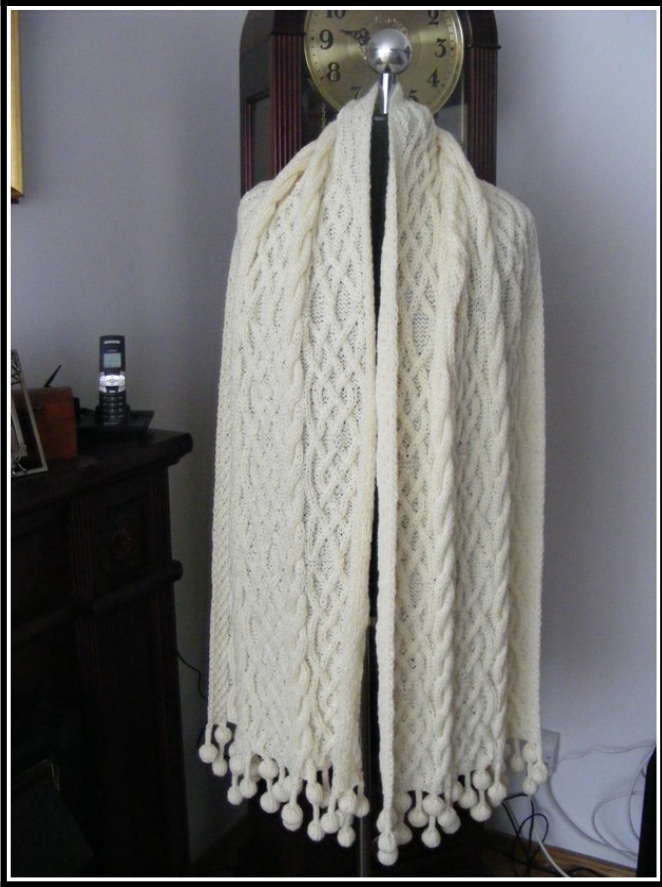 These are just a few of the modifications you can make to the cabled braids to create spectacular edges. The other possibilities are endless. There’s so much you could do with the cables themselves.I have a friend, Dorota, who’s a designer in Poland. Here is a picture of a shawl she made using the same basic concepts of multiple stranded braids. You’ll notice that her edges are smaller cabled edges. She chose to use the same braid a multiple of time and separate each panel with a regular cable. If you would like to get this pattern, here is a link to her page on Ravelry where you will see this and many other fantastic designs she has created. DEVORGILLAS ON RAVELRY
So whether it’s for a scarf, a sweater, or blanket, pay attention to the details when you’re designing. An pay particular attention to the edge – we wouldn’t want you falling off it!
Hugzzz 😎