As promised, I have a pattern for a cable braid of 12 strands. Better than that though, I have worked out several mathematical relationships between the number of strands, number of stitches, number of rows, and even the number of extra purl stitches needed to account for the edge strands. I also made another discovery that is really exciting. If you have a 16 strand braid for example, it will also include all the other braids before it (14, 12, 10, etc) , it inside it. You have to be careful though, as you have to also account for the extra purl stitches needed. These are needed because you need to travel the edge strands outwards to keep the braid intact. So I will post the pattern for the 12 strand braid further in this post, but I am in the process of writing a little ebook that will try to demystify cables in general, and braids in particular. I will include the Malcolm Matrix, a charting of the 24 strand braid ( a whopping 114 stitches and 88 rows) that will allow you to decipher all the braids below it as well. It will also include all the mathematical formulas that will allow you to calculate the pattern for any sized braid!
You might be asking what in the world would you need a 24 strand braid for? Well, once you see how these braids come out you’ll quickly realize that you can use combinations of them in almost everything. A sweater made in the round with a large braid could be very interesting. I have been planning on making a heritage blanket for quite some time now and I am going to be using certain variations of braids as the main focus. I have already started a “swatch” using the 8 and 16 strand patterns (yup, I’ve already done the 16 strand pattern) that I hope to have in pictures for you tomorrow. You could even just throw in a 8 strand or so here and there in a pattern. The possibilities are limitless, but what I find interesting is just the process of developing the patterns and understanding how these braids behave. Don’t worry, I’ll keep you posted with my findings.
So since the 12 strand pattern is over 40 rows, I decided to chart it and represent it that way. This also gives you a chance to see the general shape of the pattern. The braid is worked over 40 rows and 54 stitches. As with all the other braids, it looks best placed on a bed of reverse stocking stitch. Here it is:
Stitch Glossary
C4F: Take 2 stitches and place them on a cable needle, holding at front of work. Knit 2 stitches from left hand needle, then knit 2 stitches from cable needle.
C4B: Take 2 stitches and place them on a cable needle, holding at back of work. Knit 2 stitches from left hand needle, then knit 2 stitches from cable needle.
T3F: Take 2 stitches and place them on a cable needle, holding them at front of your work. Purl 1 stitch from left hand needle, then knit 2 stitches from cable needle.
T3B: Take 1 stitch and place it on a cable needle, holding it at the back of your work. Knit 2 stitches from left hand needle, then purl 1 stitch from cable needle.
T4F: Take 2 stitches and place them on a cable needle, holding them at front of your work. Purl 2 stitches from left hand needle, then knit 2 stitches from cable needle.
T4B: Take 2 stitch and place it on a cable needle, holding it at the back of your work. Knit 2 stitches from left hand needle, then purl 2 stitches from cable needle.
Squares with a dot are purled on the right side and kit on the reverse. Squares that are blank are knit on the right side and purled on the reverse.
On all even numbered rows stitches are worked as they appear.
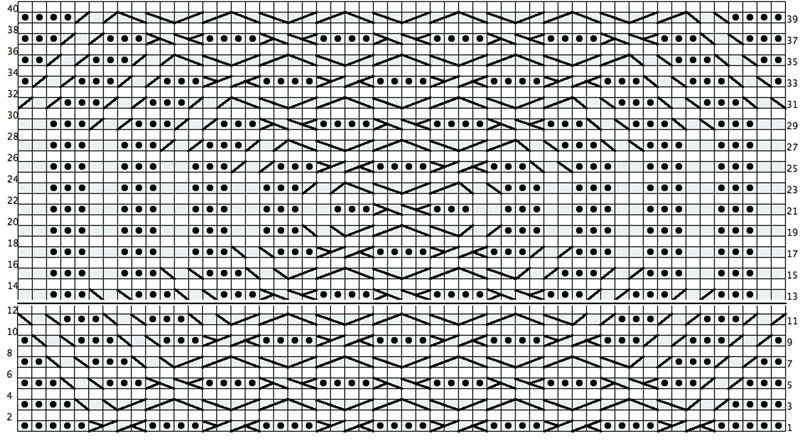
12 strand braid pattern - anyone want to name it?
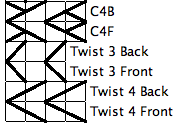
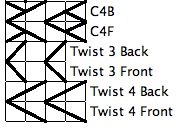
The stitch symbols ...
Special thanks to Jacquie for her charting program which made charting this much easier than using Illustrator! Enjoy and let me know what you think and do with these!
Hugzzz 😎