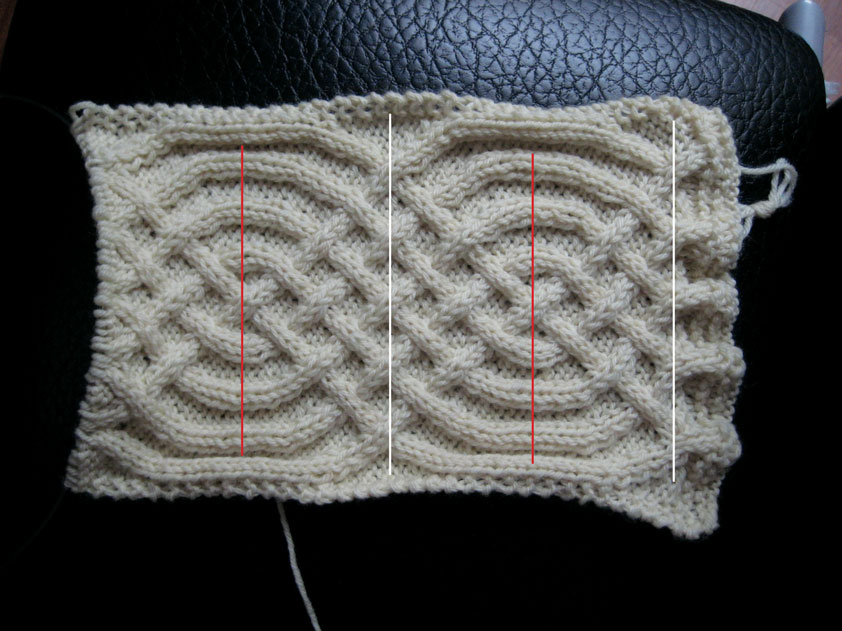
Hey, I hope everybody that celebrates it had a great Easter! Guess what? I did a cable braid of 10 strands! Yup, Barrington10 has been created. As it turns out, the 10 strands take 32 rows to do and like with the 8 strand, you have to do two repeats of the pattern to get the full effect. When you first look at the braid it looks like the BB or the Saxon, but wider, which it is. The thing that I noticed is the ever increasing lattice diamond in the middle of the braid. It is a by-product of the traveling of the stocking stitch “ropes” of the braid. Since they go in and out, they form a diamond in the center before they reach their destination, then they intersect again as they continue to travel throughout the length of the braid. This is why you need to do two repeats of the pattern to get the full effect of it. Depending on where you start the pattern, you will see either the diamond or the curving and interlocking of the braid. This is a little clearer in the picture below.

The Barrington Braid with 10 strands ...
If you look at the picture above, you will see the new braid over a total of 64 rows. The pattern is a 32 row repeater, and is represented in two sections. There are 32 rows between the white lines and 32 rows between the red lines. As you can see, the sections represent different parts of the overall pattern. Here are two pictures to show exactly what I mean …
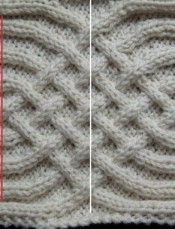
32 rows showing the diamond panel ...
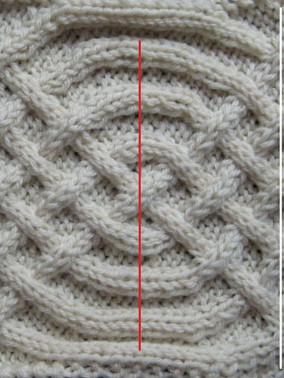
32 rows showing the braid curve ...
So now what I’m wondering is what is the mathematical correlation between the number of strands in the braid, the number of rows in the pattern, the number of stitches required, etc … I have already figured out that the diamond lattice is equal to half the strands in the braid (Saxon has a 3x3lattice, BB has 4×4, B10 has 5×5). I am pretty certain that there is even a mathematical formula to actually write the pattern. which would make it a lot easier than inventing it with each strand number (although this is only for even numbered strands so far). Yup, I’m going to work on that one now as I have 3 braid patterns to work from and you can see there is a correlation. It makes sense as the braid pattern is similar, there’s just more strands to work with. I can even envision having the formula so I can just decide on the number of strands, and knit a blanket (or whatever) of any width accordingly. There can be numerous combinations between braids with different numbers of strands and have them interweaving with each other and then out again – the only thing you’d have to pay attention to would be the row repeats. I’ll try charting the next one to see if it makes it easier to figure it out – knitting these panels does take a bit of time – especially if you make a mistake and have to frog it! Hey, just a note, if there’s any mathematically inclined readers/knitters out there that want to have a go at this, please feel free to let me know what you come up with. Oh man, I could easily spend a month or two just working on this. I’ll keep you updated but I have a pair of boxers and a beaded opera glove to go finish!
Hugzzz 😎