There are lots of ways to cast-on stitches for toe-up socks. You can do a conventional twin-tail or long tail cast-on and then graft them together, or a figure 8 cast-on, or even a provisional cast-on. Sometime ago, an ingenious knitter developed the technique I like to use the most when casting on for toe-up socks (and other things as well). It’s called Judy’s Magic Cast-on and it was developed by Judy Becker. Judy used to blog but hasn’t for awhile, but you can still find her on Ravelry (JudyBecker) and Twitter @JudyBecker. You can still check out her blog as it is still up and peruse through her posts … Judy’s Blog.
Now this cast-on isn’t really magic, you actually have to do it,but it’s as close to magic as you’re going to get without a trip to Neverland. I could describe it with diagrams and words as it’s really easy to learn, but instead I’ll show you a video by the inventor of the cast-on herself, Judy Becker. I recommend you watch the entire thing as Judy is very thorough and even shows some mistakes you may make and how to prevent them. Here we go …
You should practice this with a slightly thicker yarn so that you are comfortable with it. Knit a few rows after you’ve cast on and have a look at the outcome. Don’t worry about the tail, we’ll darn that in at the end. Now that’s a lot easier than the Kitchener stitch, huh?
So now that you’re comfortable with the cast-on, let’s actually do it. Oh, but wait … how many stitches? I’m glad you asked. Take the swatch you made yesterday – you did make one, right? Now using that,find out your number of stitches per inch. Now measure your foot or paper trace of the foot you’re making the socks for. If you look at the diagram below of the foot I’m making the socks for, I’ll be measuring the red line. Depending on the foot you’re pleasing with these socks, you might want to adjust that line up or down.
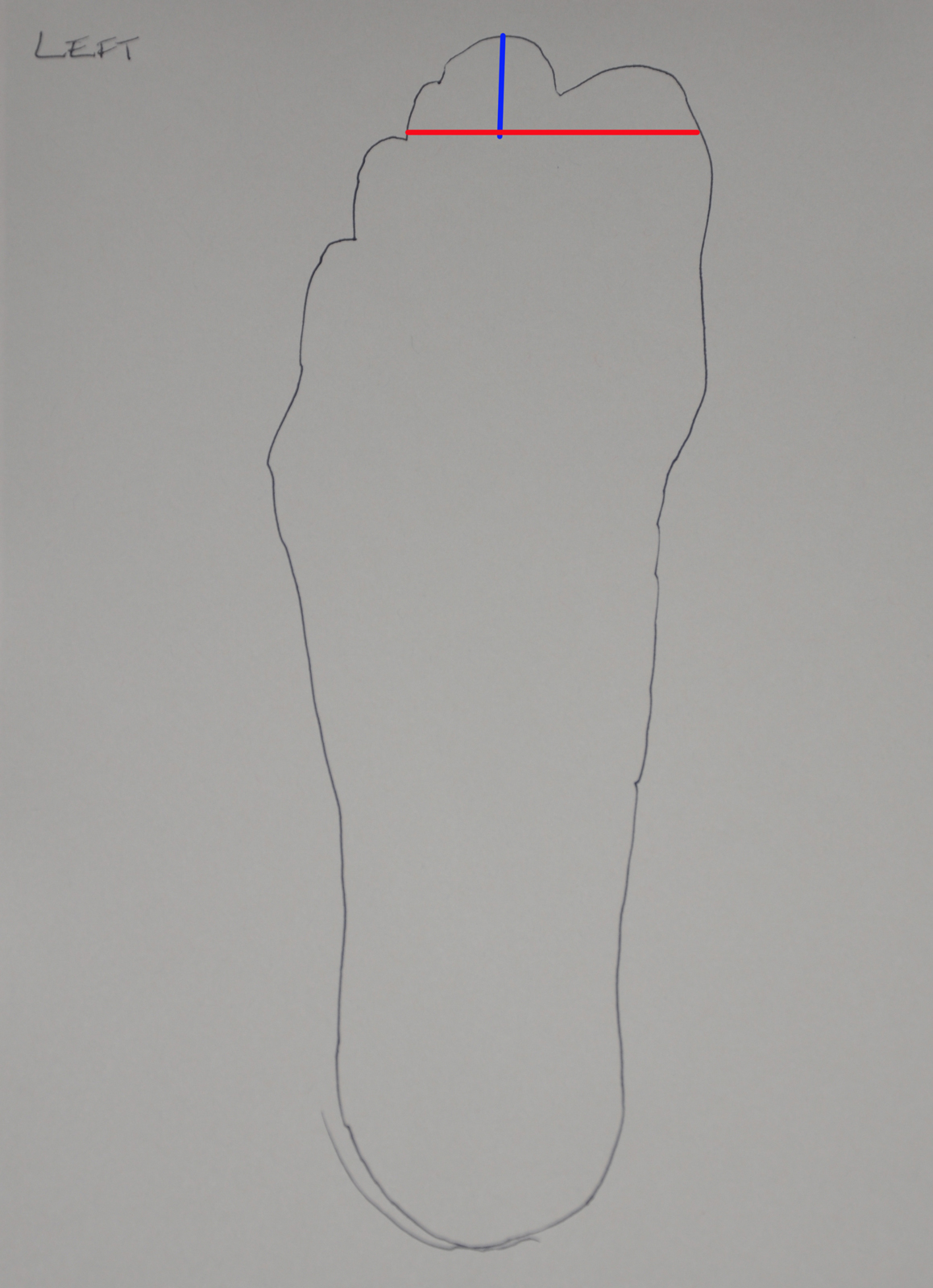
For this measurement I like to use the distance from the edge of the big toe to the edge of the second or third toe. I also measure at about the middle of the nail on the big toe. This will give you the length you need for your cast on. Now because we’re working in the round, we’ll need to double that number, so multiply by 2. Now multiply that number again by the number of stitches per inch you got from your gauge. This is the number of stitches you need to cast on.
Once you have the stitches cast on, you need to knit a few rounds. Depending on your foot, you could start shaping right away (increasing stitches), but I usually like to do a few rounds before starting that. You’ll see a blue line in the drawing. I’m going to knit that much before I start any shaping. To find out how many rows that is, I’m going to get my row gauge from the swatch I did, measure the length of the blue line, and multiply these two numbers. So if that blue line was 1.25 inches and I got 10 rows to the inch, I would knit 13 rows before i start my shaping.
So that’s your homework (or transit work if you knit in public). Remember to make 2! Yes, 2! We’re making both socks at the same time, though not on the same needles. So you’ll need to place your stitches on a holder and start the second one once you finish the first. There are 2 reasons for this … so that you’ll remember the work and tachniques better, and so that at the end you have a full pair of socks – not the one sock syndrome! Good luck!
Hugzzz 😎