My apologies to everyone who tried to view this in the last few days. My site was down due to an upgrade of the hard drives by my ISP, but unfortunately, the hard drive with my website on it had some issues and needed a recovery from backup files. As a result, my website along with some others were unavailable all weekend. The good news is I’m back! Yeah!
So now it’s time to March into spring … sorry, I had to! Even though I’ll be working on an unspringlike project. Remember the sweater that we started designing about 3 weeks ago? Well, it’s time to get back to it! I believe we were at the stage pf making a swatch. The thing is, we’re going to be knitting this sweater in the round, and as such, this provides a few challenges. The first and foremost is knitting in the round! Since I’ve been knitting for quite a while now, this isn’t an issue for me, but talking to knitters on a regular basis, I’ve come to realize that this isn’t so for everybody. As a matter of fact, there are a lot of knitters who have never knit in the round before. So I’m going to take this opportunity to do a little teaching and go through the process of knitting in the round.
There are a few common ways of knitting in the round, but only four of those are practiced regularly. We’ll mention them here and then go through them in detail over the next few days. The ones that most knitters are most familiar with are using:
- Double Pointed needles
- One Circular needle
- One circular needle using the Magic Loop method
- Two circular needles
In most instances, the first thing you knit in the round is probably going to be a hat. Yes, I have known very eager people who learned how to knit socks right off the bat, but that’s not the norm. I’ve seen a lot of people start to knit in the round by picking up a hat pattern and getting a 24″ or sometimes even a 16″ circular needle. So yes, we’ll start with method number 2 – using one circular needle. Below is a picture of a circular needle.

If you look at it closely, you’ll notice that a circular needle is basically just 2 double pointed needles that some sort of flexible connection between them (usually nylon). It’s very important that the connection be flexible, and the more flexible the better, IMHO. Just like straight needles, circulars come in varying sizes and are made from various materials, each having their own distinct properties. As well, the connection between them varies in length as well. Which ones you choose is entirely personal and may change depending on the project and the fiber being used. When suggesting what new knitters should get I usually tell them get circulars in a material you like with the longest connector you can find (more on that later). My favorite needles are 40″ circulars, sometimes 47″ or 60″.
So what do you do with this fandangled thing in your hands right now? Well, if you’re making that hat and using the method 2 (one circular), you’ll want to make sure that that needle is no longer 24″ (unless you have a REALLY big head! Well, you’re going to knit with it, just like you would with two needles. Well, you’ll start that way. Cast on the number of desired stitches onto your circular needle. It should come close to fitting around the whole needle with the stitches loosely spaced around. If the are too stretched out your nylon is too long and you’ll need a shorter needle. It should look something like this … Thanks to Stitchdiva for the picture …
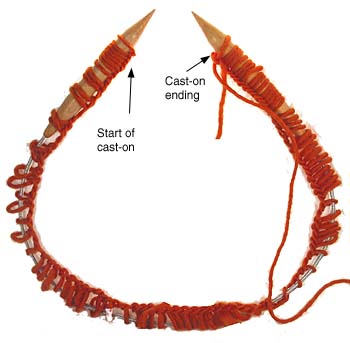
Now all you have to do is start knitting by joining the last stitch on your right needle to the first stitch on your left needle. Be careful not to twist the stitches when you join them and you’re off to the races. It really is that easy. Two things that you should note about knitting in the round on a circular needle (or DP’s for that matter). The first is that you’re actually knitting a spiral, which can be problematic in specific situations (we’ll talk about that later as well). The second is that you’re always going to be looking at the right side of your work, so you have to allow for that in your way of thinking. If you’re reading instructions from a chart and have converted it to circular knitting, you’ll always read right to left! Also, sometime the wrong side row instructions aren’t given or they simply say, knit what you see. When you get to the beginning of the round, you’re actually starting a new row and you should think of it as such. I should also point out that it’s easy to lose track of the beginning of the round, so you’ll want to put a stitch marker between the last and first stitch so you know where your round begins! Since you’re always looking at the right side of your work, if you’re making garter stitch fabric, you need to knit 1 row, then purl 1 row, and alternate these two row. When knitting in the round, to make stocking stitch, you simply knit everything!
Now as long as you have enough stitches to go comfortably around your circular needle, you’re great! Just keep knitting. If you decrease stitches however, you may need a different technique. We’ll get into that next time! 😉
Hugzzz 😎