Okay, it’s time for our last swatch, but before we do that, it’s also time for some changes. By now you’ve gotten used to putting holes (YO’s) in your work and you’re worked a single left slanting and right slanting decrease as well as a double decrease. You don’t know everything about lace knitting yet, but you’re well on your way. There is more to learn but we’ll tackle it as we get to it. In the meantime we need to discuss yarn and casting on. Let’s start with yarn. We’ve been using DK weight yarn for our samples – this was just to get you used to the whole lace thing. DK weight yarn is fine for some lace projects, but typically when making a lace project you’ll be dealing with much thinner yarn than DK. How much thinner? And how can you judge the thickness of yarn by looking at it if it isn’t marked? The most reliable way of determining a yarn’s thickness is the WPI method. WPI stands for Wraps Per Inch. To determine a yarn’s WPI, take a pencil or ruler, and wrap the yarn around it for 2 inches (more for thicker yarns). Keep the wraps right beside each other and do not let them overlap. Count the number of wraps and divide by the number of inches you wrapped. This will give you the wraps per inch for the yarn you are working with.
Lace weight yarn will be anywhere from 16 wraps per inch or more – typically 18 and over. There is usually 2000 (at the low or thick end) to 2600 (at the thinner end) yards per pound of yarn. You will also typically get anywhere from 7 to 10 (or more) stitches per inch with lace weight yarn. At the lower end you’re working with sock weight yarn and at the top end that is what is usually referred to as ultra fine, baby, or lace weight yarn. As the yarn gets thinner, the recommended needle sizes get smaller too. As you know, DK usually calls for 4mm needles, while lace gets as small as you can handle. Typical lace is knitted with needles in the 2mm – 2.75mm range, although it can easily be smaller or larger. For this swatch, try and find a yarn that will use 2.5mm needles or close to that. This will truly give you an appreciation for using finer yarns and small needles. The yarn itself will give you better results if it is a natural yarn or blend of natural yarns. This is because we will definitely want to block the work later on. As you get smaller, the yarn doesn’t have the same strength to support the stitches as a thicker yarn does. This means that the shape won’t be as evident as you’d like and blocking will be necessary. I am going to use a fine pure wool that I have in my stash, but you should use anything you have handy.
If you’re doing a circular pattern and working from the middle outward, you want to make sure you cast on loosely, but it is not as crucial as when you’re doing a triangular or rectangular shawl or wrap. If you cast on too tight there will be a pucker on the first row and you’ll be disappointed with the result later on. There are several ways to cast on loosely and you can choose whichever you find most comfortable. My favorite method is to use the long tail cast on but using two needles. Circular needles work great for this as you can place both ends of the needles together and cast on. The Provisional or Invisible cast on is also a common one in lace knitting. It allows you to cast on with waste yarn and then begin your project, with the waste yarn to be removed later. Here is a link with Lucy Neatby demonstrating the technique.
Try it with some yarn before trying the swatch below.
The last thing to talk about before we try the next swatch is lifelines. Lifelines are a good thing to practice when doing lace knitting, whether or not it is a complex pattern. They are a line that you put in your lace knitting at regular intervals to reduce the number of rows you’ll have to frog if you make a mistake. You’ll want a smooth yarn that is thinner (or the same thickness) of the yarn you’re knitting with. Crochet cotton is a great lifeline and readily available. You can also use dental floss – the Ultra Glide type is great for this! Your lifeline should be longer than the width of your project so that you don’t have to worry about losing stitches from either end. To attach your lifeline, thread it through the loops of your stitches on the needle before starting your next row. You may find it easier to do on the reverse side as the bumps from the purl stitches makes it a little easier to see where the needle with the yarn should go. Don’t thread the lifeline through your stitch markers! This is a mistake you’ll tend to only do once. It is also a good idea to put the lifeline at each repeat or every 10 or so rows. If it is a very complex pattern and you have a lot of stitches, you may want to do it more frequently. If it is necessary to frog back to a lifeline, remember to do it gently and stop the row before you get to the lifeline. Then you can take the last row stitch by stitch and place them on the needle as you go.
Okay, so a quick recap on what you’ll need …
- thin yarn for the swatch (a natural fibre is best)
- small needles to match the yarn (2mm – 2.75mm is a good start)
- lifelines (2 is all you need but you can go with more if you have the yarn)
Now we just need a pattern to work with. Try one of the ones below and knit enough repeats of it so that you get a chance to put in a lifeline a couple of times. Since both are 36 row repeats I would recommend putting in the lifeline at least half way through or even every 10 rows. Also, try the provisional cast on and don’t worry about a border, but still put on selvedge stitches. The key is the same for both patterns and I haven’t given you a picture of what it looks like. This is partly for you to gauge how well you can read a chart pattern and for you to get used to visualizing the finished piece from a charted pattern. Have fun and here are the swatches …
The Key is the same for both patterns.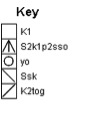
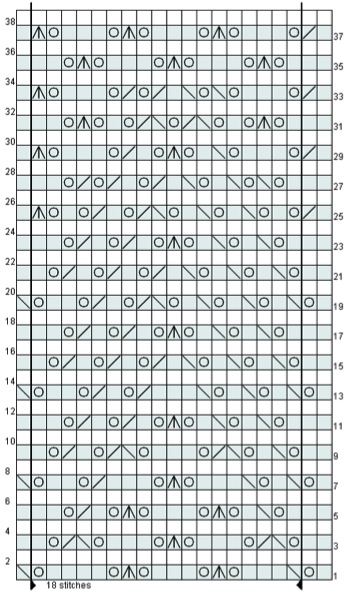
Pattern 1
*UPDATE FOR PATTERN 1 *
On the last repeat on the left side, all rows ending with a double decrease (25, 29, 33, 37), that decrease needs to be modified on these rows to become a single left slanting decrease. This is done only on the last repeat on the left for these rows.
*UPDATE #2 FOR PATTERN 1*
On row 31, inside the repeat lines, the 8th square shows a right slanting decrease. THIS SHOULD BE A KIT STITCH! Thank you so much Antoinette for trying this swatch and letting me know of the problem.
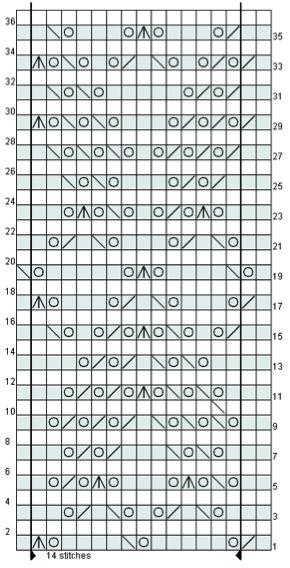
Patern 2
*UPDATE FOR PATTERN 2 *
Sorry everybody, but if you started Pattern 2 there is one adjustment. On the last repeat on the left side, all rows ending with a double decrease (1, 17, 29, 33), that decrease needs to be modified on these rows to become a single left slanting decrease. This is done only on the last repeat on the left for these rows.
With both patterns, purl all stitches on the reverse or even numbered rows. With Pattern 1, knit Rows 1 – 38 the first time, then repeat Rows 3 – 38 for an all over pattern.
Hugzzz 😎