I have been a little quiet these past few months, so it’s time to start talking again, so to speak. It has been very busy and it always surprises me when I look up and realize that another day has gone by, which turns into another week, then month, and before you know it, we’re all celebrating Christmas and the New Year! Well, I have a few posts to get in before then, so I’ll start by continuing where I left off and give a little preview at the same time …
Color can be a wonderful thing in all aspects of life, and especially so in knitting. We’ve been discussing how to incorporate color into our work, and started with simple stripes. As you may recall, I recommended using the Fibonacci sequence when using stripes as it makes your work especially aesthetically pleasing, and it comes straight from nature as well. Check a few posts back if you’re unfamiliar with this sequence or the mathematician who discovered it (Fibonacci himself).
There are quite a few other ways to incorporate color, but I’m going to jump up the ladder a bit and discuss one that I’m sure you’ve heard of, if not already used. Fair Isle. Fair Isle is actually a place in Northern Scotland where the technique of working with two colors in a single row of knitting was first developed. The island became synonymous with sweaters made using this technique as they were used to barter with passing ships for other goods and necessities. The usual method of Fair Isle knitting involves carrying the unused color in the back across 3- 4 stitches. This method, known as stranding, is very effective, but does create floats that can cause snags.
My preferred method of working Fair Isle involves weaving the two yarns together instead of the more common stranding method. The weaving occurs over every other stitch, establishing and maintaining a consistent gauge. It may sound like a lot of work to weave the unused yarn every 2nd stitch, but once you practice the technique for a bit, you’ll barely notice a difference from regular knitting and this new weaving. This weaving method can be worked on knit stitches or purl stitches but is a little easier to do on knit stitches, so is usually done with work done in the round. Since it can be done on purl stitches though, it allows you to avoid steeking when making a sweater in the round, and increases the options for the shape of the top of the sweater. For example, you can work your sweater in the round to the armholes, then go back and forth in order to make a drop shoulder sweater instead of the usual yoked or raglan style.
Since I don’t want to re-invent the wheel, I’m showing you a video made by Queenie.
You’ll notice that the left hand is working the yarn in the “continental” method, while the right uses the “traditional” method. You don’t have to be a master of either one in order to do this. As a matter of fact, I found it helped develop each method when I first learned how to do it.
Here is link to the Philosopher’s Wool partial video of doing this method as well …
Philosopher’s Wool 2 Hand Weaving Fair Isle
The reason for the 2 different videos is to show that the same thing can be accomplished using slightly different techniques. While they are similar, each knitter puts their own little style to it, however, the end result is the same. And speaking of end results, that I find is the biggest reason for learning this technique. If you saw the blanket at the beginning of Queenie’s video, you may have noticed that it’s practically reversible! If you maintain the weaving over every other stitch, you’ll have the same result.
Here’s a preview of a scarf from the calendar that uses this technique … Here’s the front or outside …

And the reverse or inside (it’s a cowl scarf) …

Notice that you can see the pattern of the braid … with the stranding method you only see floats, or lines of the carried yarn. And here’s both sides together …
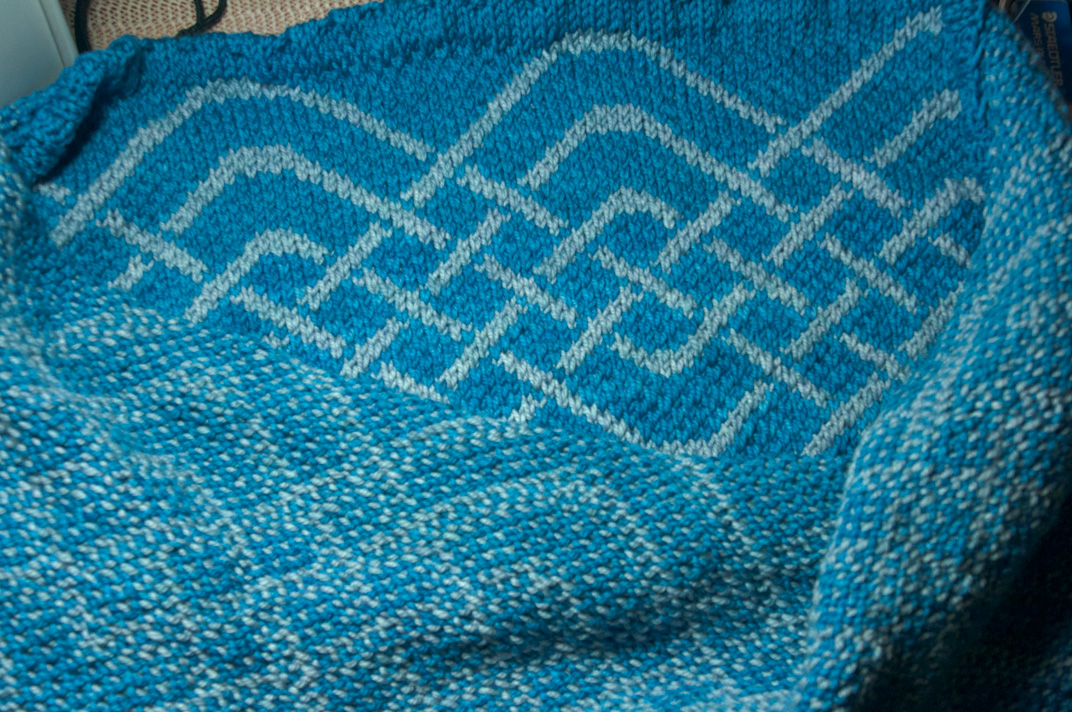
Yes, that’s the Barrington Braid, but done in Fair isle! You’ll see it in the calendar and shortly after Christmas as a stand alone pattern. I’m working on a few ideas with this as well that will hopefully make it worthy of being the Barrington 4.0!
Hugzzz 😎