No, I’m not talking about being a dog and knitting, although that would be a great trick to teach a dog, wouldn’t it. What I am talking about is knitting on four needles. If you mention double pointed needles (called DPs) to a knitter, the first thought that comes to mind is socks. As a matter of fact, most people use four or five double pointed needles to make socks. While it does sound a little daunting and takes a bit of getting used to, with a bit of practice a beginner can become quite adept at using four needles quite quickly. The trick is, once you break it down, you realize that you’re only ever using two needles at any one time! Let’s do just that and look at the process in more detail.
First, let’s look at the concept of using four needles as opposed to two. The reason we are using four needles is because we want to knit a tube without a seam. If we used two needles we are limited to going back and forth and have to sew it up in the end to get the tube – this means having a seam. If we remember basic geometry and shapes, we know that we can inscribe a circle inside of a triangle or square. As a matter of fact, you can use any number of needles from 3 onwards to knit in the round (I wonder what the Guinness Record is?). Let’s keep this simple however and stick with four. So if you have four needles, let’s start by equally dividing the number of stitches we have on three. Again, let’s keep this simple and use 30 stitches. Using a needle of the proper size (this can be one of the DPs or another), cast on 30 stitches. Now equally divide them so you have 10 stitches on each needle.
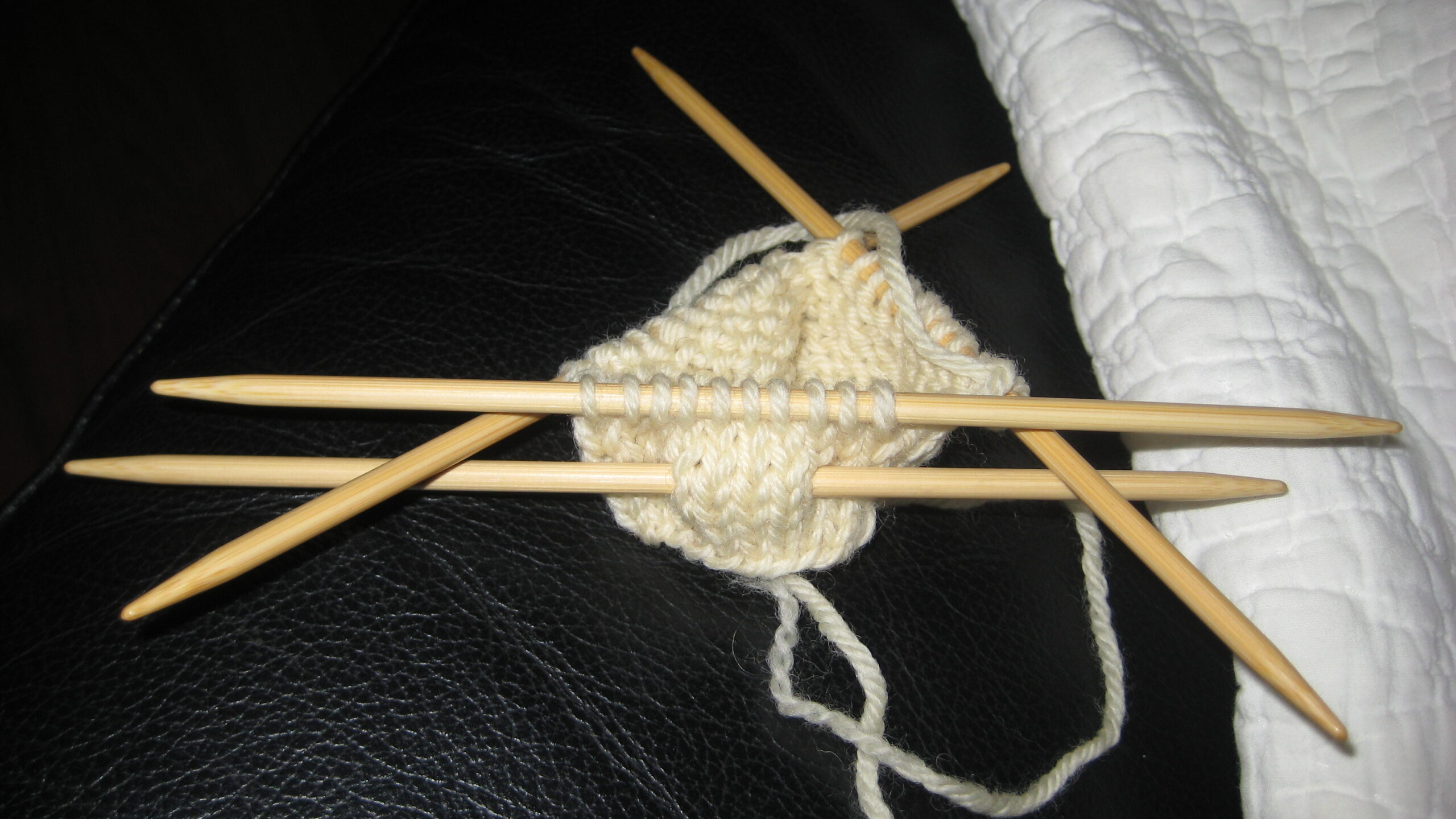
30 stitches evenly divided on 3 DPs - the fourth is used to knit the stitches.
Your contraption should look something like a 3-pieced numchuck. Let’s label each of these needles from 1-3 with the last needle being the 3rd. Note that the last needle has the yarn dangling from it. I use this way to know where the beginning and ending of each round is, but when beginning you should place a marker here for ease of recognition.
Now, just as if you were using circular needles, if you want a tube you need to join the last stitch to the first stitch. Be careful not to twist your stitches when you do this or you will be making a Moebius strip and that’s a lesson for another day. You will have noticed that we have only used 3 needles to this point. Now’s the time to pick up needle number 4, and start knitting into the first stitch of the first round on needle number 1. That’s the one with needle number 3 sticking into it – the join we started in the previous step. You have now knit the first stitch on the 1st round (you generally don’t count your cast on row as a round.). Continue in this manner until all the stitches from needle one have been knit onto needle four. Now you’ll realize that needle 1 is empty, and needles 2, 3, and 4 have stitches on them. Repeat this process twice more first with needles 1 & 2, then 2 & 3. You have completed another round. If you have labeled your needles (a good practice when first learning this technique), then you should have needle 3 in your hand and needles 4, 1, & 2 have 10 stitches on them. You should also have a join and the beginning of a tube. All you have to do now is continue until the tube for your project (hat, socks, sweater) is where you want it.
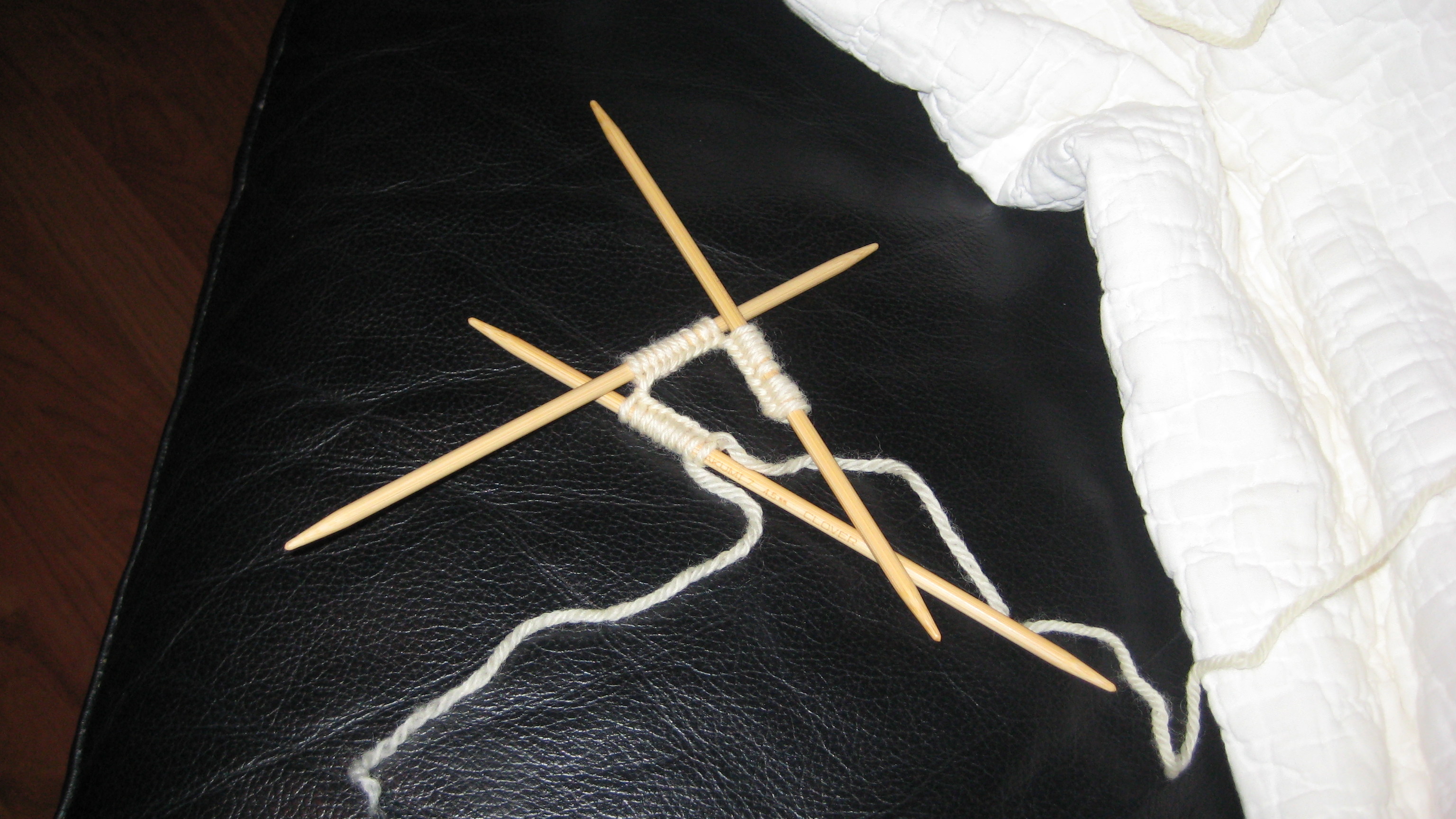
A look at the work a few rows up - the fourth needle (empty) is in the work just to show it.
Congratulations, you now know how to knit on all fours.
One of the great advantages of knitting on 4 needles is that we can make a tube of any size from 3 stitches up. Since 3 is the minimum number of points you need, this allows us to make almost anything. By using a little ingenuity however, we can use DPs in a number of ways. Using longer DPs allows us to make a larger project than we would be able to with regular straight needles or if long circulars were unavailable. You could also use different sized DPs in a chain and then different weights of yarn in the same project. You could even see how many you could use t make the biggest tube you can and go for that Guinness record I mentioned earlier. Whatever you decide, have fun and practice this technique. It will be an invaluable part of your knitting experience!
Update: There will be pictures for this post to follow later but I am off to work fr a 6:30 am start at the time of this posting. I will update it later this evening when I return home. I also plan on winding the yarn for the Jamaican sweater and doing a swatch!
Hugzzz 😎