Hmmm … you know that saying about the best laid plans? Well, I’m afraid this summer top KAL is one such situation. I went to the store today to have a look at the top and I have to say I was totally disappointed. As a matter of fact, I’m trying to figure out how they got the picture to look so good! Yes, in real life the garment does not look nearly as good as the picture. could we have been duped? Perhaps. But all is not lost. I still intend to go ahead with the KAL, creating what the picture depicts, and not what I held in my hands scant hours ago. After inspecting the garment, the reviews were right. There is an impossibly wide/long armhole that basically stretches from shoulder to about 2 inches above the waist. The fit is truly just a large box with a neckline, and the cowl, well … the cowl was cleverly attached to provide the two ways of wearing it, but it still could have been done better. I guess I was disappointed with the overall quality of the garment. Rather than sweatshopping this in China and charging a bargain price, the manufacturer could have made a very unique piece and increased the price point. Even though they decided to do it in China (yes, the label is there), they could have paid more attention to the details and created something as spectacular in reality as it is in the images.
So what are we going to do? Just that! Having seen the piece I definitely have ideas on how to construct it and make it what we all thought it was. I’ll lay out the plan and welcome your thoughts. If you have a chance to go to the store (if there’s one near you), please do so so that you may be able to help me out as we go along. So here is a basic idea of how the particular garment was constructed so that you have an idea of where I’m planning on going with it and you’ll be better able to give relevant suggestions.
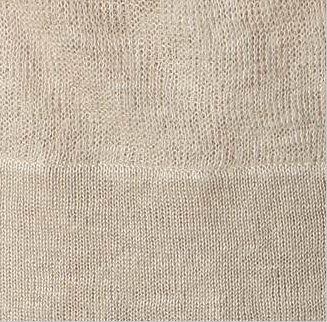
- Starting from the hem, the linen was doubled to increase the density of it at the bottom. It’s knit in a fairly tight gauge so that when it’s doubled it has a bit of weight at the bottom. This is a good thing as it helps keep it on your hips and not rising up or blowing away all the time. You can see what I mean in the picture at the left.
- At the waist there is a seam (good spot Martha) that joins the cowl with the body of the sweater (I’ll explain that a little later). At this point the remaining body of the top (it’s not a sweater so I’ll stop calling it that) is knit singled in about a sport weight (6sts to the inch) gauge with a slightly thicker linen than the base. The cowl is knit with a linen that is definitely fingering weight gauge, but knit in a medium density gauge – not too thin but definitely not as thick as the top.
- The cowl is simply a large rectangle that is attached to the top at the waist seam (right around it) and then along the sides to the shoulder. The entire garment, including the cowl, is knit in pieces and then it is all surged together at the appropriate seams. In actuality, this is a very clever way to get the cowl attached, and since it is lace weight, it doesn’t add too much warmth, yet would be appreciated if there was a slight chill or to just cover the shoulders.
How can we create this piece and/or improve on it? Well, my thoughts are this …
- I like the way the cowl is attached, and it is very functional. The problem is that it creates a seam at the waist that is very visible when it is worn on the shoulders. It is not as visible when worn off the shoulders. I’m thinking of making a separate cowl and find a way to attach it to give you three tops in one (again, good idea Martha!).
- I don’t like knitting the base in a tighter gauge and doubling it. Again, if i were using a knitting machine, sure, it would be a snap, but by hand, it is hours of needless knitting. I’d rather do the entire top in a sport/DK weight yarn in the fiber of my choice.
- If you saw the actual garment, you’d shudder at the sizing and shaping, or lack of it. I’m going to make this a more fitted piece to accentuate the curves of the woman wearing it. Hey, us guys love to see your curves, not just a box around them.
- Since the cowl will be a separate piece, I’m going to make this garment in the round, instead of having all those seams. I might even be able to attach it afterwards, but I’ll keep my options open since I’m not sure. Then again, since I am making two of them …
- Since this is fitted, I’ll do it the same way I did the sock KAL last year. Instead of having specific measurements, I’ll explain how I get my figures so that you can customize it to your body size and shape. If you’re close to the sizes I’m doing, you’ll be all set. If not, you’ll only need to do some minor adjustments.
Great, so now we’re almost ready to get started. Since there have been some changes in the gauge of the fabric we’re going to make, you may have to change your yarn. I’m still going to use the Silke Tweed by Drops, as I knot up a swatch and got 22/30 stitches/rows over 4″/10cm. That’s an almost perfect DK weight. Don’t worry if yours is a little tighter, we’ll be calculating stitches as we go along and working this out together. Just make sure you’re using a fiber you’re happy with. You also want to consider the color carefully as you’ll probably end up making the cowl in a different fiber/color altogether and you’ll want to have something that will be easy to match. Here is my swatch …
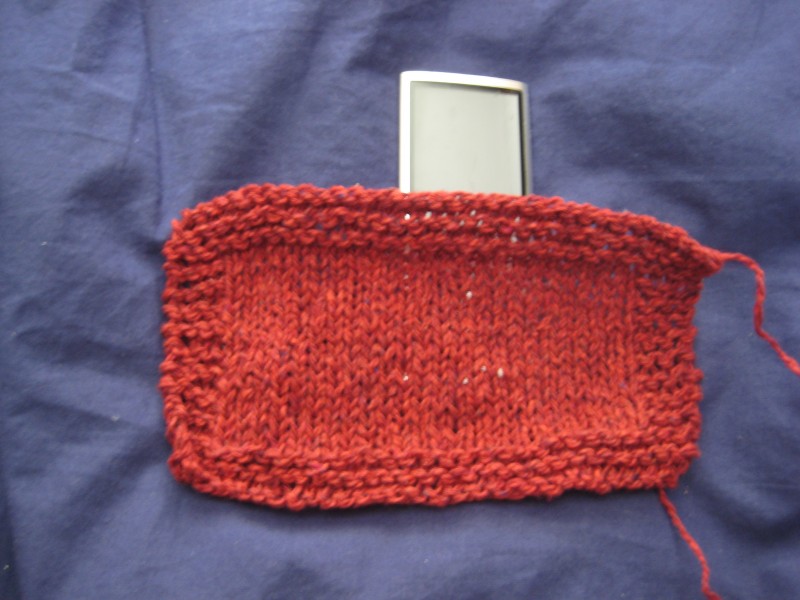
That’s an iPod Nano behind it so you have some idea of the scale. The actual color is a slightly darker red. Depending on how we decide to attach the cowl later, I might even use the same yarn. So now that we have a game plan, your homework is to pick your fiber and knit a swatch you’re happy with. Once you’ve done that measure it, as you’ll need to know the # of stitches per inch for the pattern! See you on Thursday!
Hugzzz 😎