Yes, today being Tuesday should be Tuesday’s tips, but unfortunately I have a cold and was unable to post this yesterday, so I’m doing it today. This is the last week of the color escapade we’ve been doing, and there are a few surprises in store. I should let you know that there will be a contest at the end of his, and one of the prizes will be the book The Essential Guide to Color Techniques by Margaret Radcliffe. If you missed the review of it, search back a couple of weeks when we started all this and you’ll find it. There will be 2 other prizes as well, so make sure you’re paying attention. We’ve already looked at a variety of ways to incorporate color into our work while knitting, including but not limited to stripes, intarsia, shadow knitting, and double knitting. Today we’re going to delve into probably the most well known, but hardest of the bunch – stranding.
Stranding is a method of carrying along 2 or more colors of yarn and interchanging which one you use throughout the row. Stranding is often referred to as fair aisle, but incorrectly so. Fair aisle is stranding where you have 2 colors in the row, where stranding is only limited to the number of colors you can work into the fabric. We will use fair aisle to take a look at stranding, as it is simplest to do 2 colors and you’ll still get the idea of what is happening. As I said earlier, stranding allows you to carry more than 1 color along your work and knit with whichever one you want. The color being knitted shows up on the front of the work and the one being carried along is hid on the back. Because of this stranded work is usually limited to garments that don’t show the inside – sweaters, hats, etc. Blankets, scarves, and other flat creations don’t work well for stranding and usually incorporate a different technique for adding color.
Even though you have a definite right and wrong side, stranded work is amongst the most spectacular type of knitting you can have. You can literally “knit” a picture into a garment or designs, or anything you can think of. Geometric designs work great for stranding – especially ones with 2 or 3 colors. You are not limited to just2 or 3 though, as Argyle patterns will incorporate up to 6 and sometimes even 8 colors into the pattern – with 3-4 in the same row sometimes. Truly skilled knitters can strand with 2 colors in one hand and 2 in the other.

But before we get too far ahead of ourselves, let’s have a look at techniques for stranding.
Traditional Stranded Knitting with 2 colors – In stranding with two colors in traditional knitting, the simplest technique is to pick up the color you are working with and knit a few stitches. After every 3 or 4 stitches, overlap the second color over the color you are knitting with. The color you are knitting with will “carry” the second color along on the back. This creates a “float” or “strand” on the back and is the main reason why stranded knitting is not reversible. You need to “strand” the second color regularly, or your floats will change in size and your fabric will change in tension. It is necessary to keep consistent throughout the fabric to prevent any puckering or loosening of the fabric.
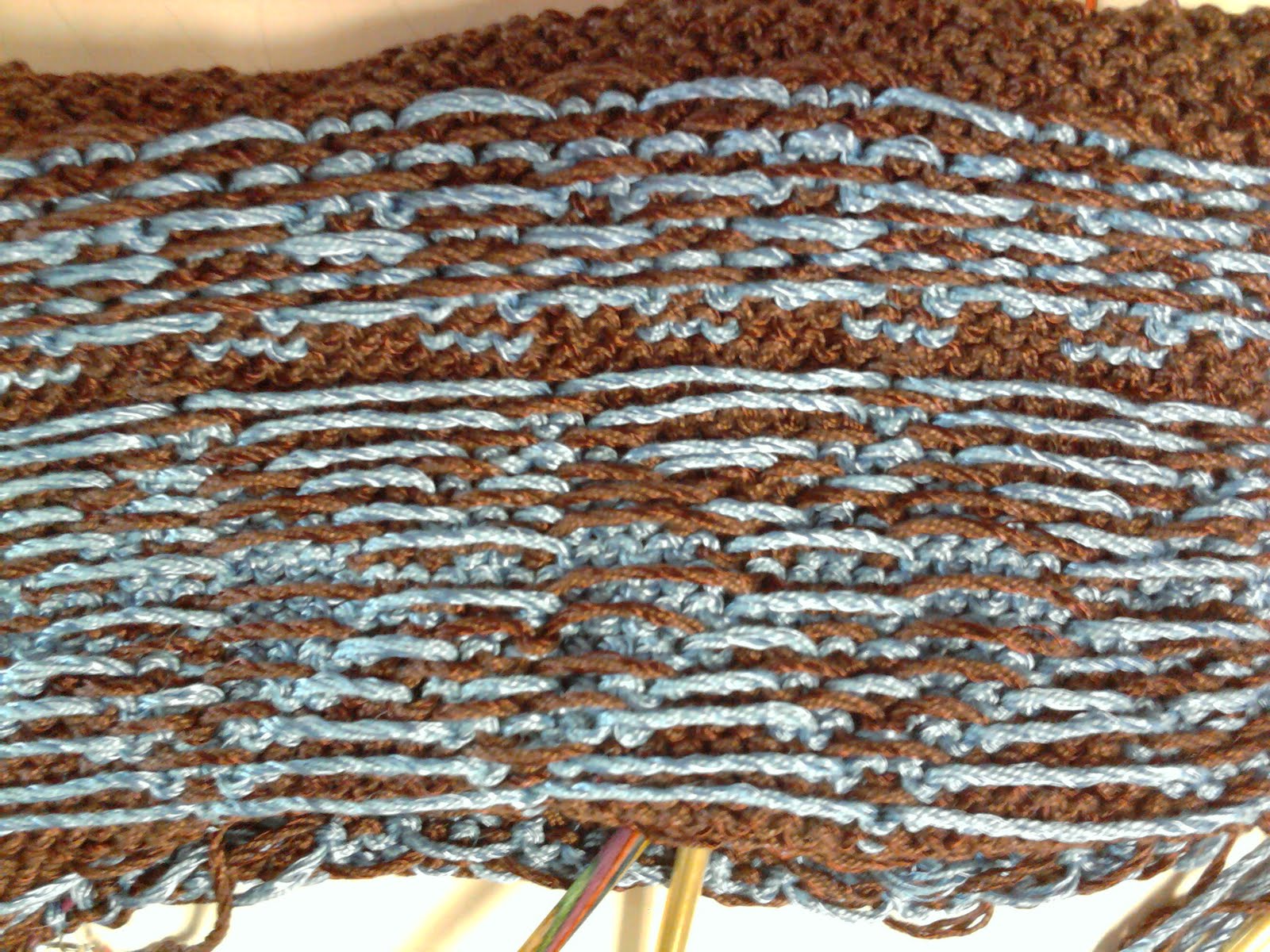
It is not usually a good idea to have your floats too long, especially when making garments for small children or toddlers. The longer the floats, the higher the likelihood of fingers or toes getting caught in the strands. A longer strand also creates a looser fabric which will have a tendency to sag and stretch more and quicker than a tighter knit weave. Although it is time consuming, the results are well worth the effort. Once you have gotten used to using two colors, you can try carrying the two colors on your index finger and carrying them along together as you work. When you “throw” the yarn you are knitting, you allow the other to remain on your finger, eliminating the necessity of dropping and picking up another color all the time. This technique takes a little time to perfect, but once you do you will see your speed increase dramatically in creating stranded knitting. Then you can tackle 3 colors … and more!
Here is a video showing this technique. You can google for more videos showing this.
Here is another video showing the same technique but doing it a little differently. remember in knitting there are many ways to do something, it just matters which one you prefer!
*Of Note – Because you are carrying another color along with your main color, the fabric you create will be thicker than one with just the single color – even if you’re only using the other color every 6 or 8 stitches (or more). As a result, it is imperative to do a gauge swatch when you are starting your work to make sure your garment will be the right size. You will also want to make sure that you are happy with the “feel” of the fabric that is being created.