I hope everyone that celebrates it had a great Halloween. Remember not to eat all your candy all at once! Here in Hugzzzland, we’re continuing our little foray into color. We’ve looked at a few different ways to incorporate color into our knitting, and have a few more to go. So far, all the ways we’ve looked at involve different techniques. Today, we’re going to look at the easiest way possible – I know I said stripes was the easiest, but this way slipped my mind until just now. I am of course, talking about yarn! Yarn has evolved since the first days when somebody picked up two sticks and some string and decided to knot it together into something. As a matter of fact, yarn has evolved dramatically in the last 10 – 20 years. Not only is it evolving in the ways it is being made and the fibers being used for it, but it is evolving in the methods used to dye or color it as well. With that evolution comes different ways that we can incorporate color into our work.
Today’s manufacturing processes and dyes allow us access to literally every color in the spectrum. But they have gone one step beyond that as well – multi-colored yarns are everywhere. In the beginning there was pretty much just variegated yarns – two or three colors dyed into a single ball of yarn so the color changed as you knit. This is a great thing to have and made for wonderful garments – especially blankets and scarves. In relatively recent times however, developments have lead to self-striping and self-patterning yarns. Let’s take a look at all three of these.
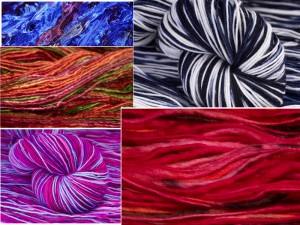
Variegated Yarns – When you think variegated, you usually think of the acrylics that are machine dyed to have three colors that change at regular intervals. As I said before, these are (were) great and provided for a lot of creativity in the knitting world. A little while ago, a company called Colinette did something that stood the variegated yarns world on its head – they created “hand painted” yarns. These were technically variegated yarns, but they were custom dyed by hand to have the same colors, but no two skeins are ever the same (well, maybe two in a million would be). Since they started doing this, everybody has come out with their own selection of unique colorways for their yarns. The exact process used by Colinette is a trade secret, but the general technique is well known and practiced by many – professionals and non alike. Some people even dye or “hand paint” the fleece before spinning it to create even more unique effects.Here is a collage of 5 of the 125 color currently in Colinette’s pallet. Clicking on the image will take you to their website.
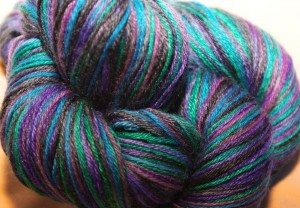
Among the more popular or well known manufacturers of hand painted fibers are Colinette, Noro, and Fleece Artist. There are many more though, including a friend of mine who lives in the UK and does some wonderful unique colorways for exquisite sock yarn. His name is Colin “Knitman” Anderson, and you can see and purchase his amazing yarns from his kitchen. Click on the picture below to go to his kitchen to see what he has been brewing lately!
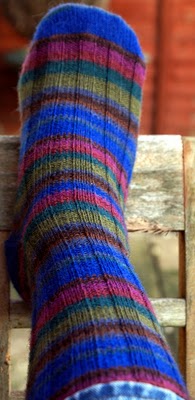
Self-Patterning/ Self-Striping Yarns – The other way(s) that yarns have evolved is in the self-patterning or striping arena. A while ago somebody used a computer and figured out the intervals necessary to dye yarn in different colors to produces predictable stripes. As you can imagine, there are many factors to take into consideration, so to help with the predictability, this has predominantly been used when making socks. There is not however, anything stopping you from using this sock yarn to make other items. Here are a few of the colorways used by Regia in their sock yarn.
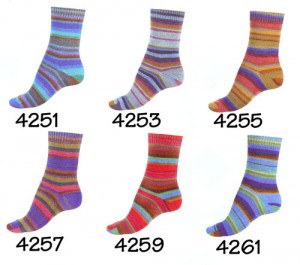
Again, after the development of the self-striping yarn, they took it another step. They then developed self-patterning sock yarn. This is yarn that is dyed in such a manner that when you knit it in stocking stitch, it looks like you did a brilliant job in Fair Aisle! How cool is that??!! also, there is nothing stopping you from using this yarn to make other objects – gloves, mitts, scarves, and even baby sweaters. As a matter of fact, because of the size, the patterns come out great with almost no pooling of colors and/or patterns at all. Now you can impress your friends and tell them how you slaved with balls and balls of yarn to make that adorable little sweater. Hey, they don’t need to know the real truth!
Hugzzz 😎