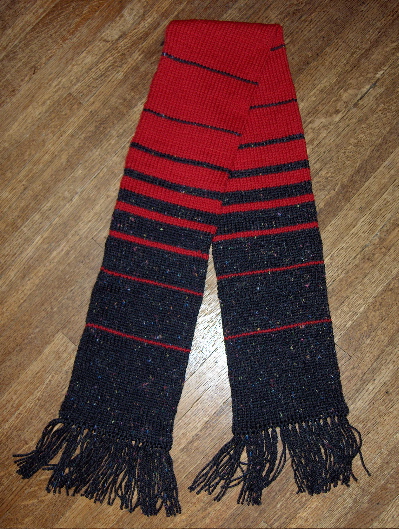
Possibly the easiest way to incorporate colors in your knitting is to use stripes – vertical, horizontal, or diagonal. Adding stripes to your knitting is as simple as changing a ball of yarn. You simply take the new stripe color at the beginning of a row and start knitting with it. If you’re going to reuse the previous color you can carry it up the side of your work (providing it’s a seam) to be picked up later when needed. The trick is to ‘hang’ it on the yarn you are using so that it gets carried neatly up the side. The alternative to this is to cut it each time but that may leave a lot of ends to weave in later. As for the stripes themselves, well, the color wheel is your oyster. You can combine any number of colors in any fashion as long as they seem aesthetically pleasing to you. We’ll do a post later this week on some ways to pick colors that blend together well and don’t clash.
If you decide on your colors, the next thing to decide is when to change your stripes. The first option is to change it every row. If you are working with an even number of colors (let’s say 2), you can work 1 row stripes without having to cut your yarn at the end of each row while knitting flat. You’ll need to work with circular needles, which you’ll have to look at as just really long double pointed needles. What you need to do is work the first row in color A – let’s say it’s red. When you get to the end of the row with the red yarn, drop that color, and slide the stitches back to the front of the needle. Now start knitting with the second color, let’s say blue. When you get to the end of the row, you’ll be where you left the red yarn dangling. Now turn your work, pick up the red yarn and knit back with that. When you get to the end, again slide the stitches back and pick up and knit with the blue. Continue in this manner until you’ve knit all the stripes you need.
If you’re working in the round and knitting single rows of stripes you won’t have to manipulate your stitches like this. You simply change the colors at the beginning of each row, which are clearly marked with a stitch marker. You will however, run into another problem when doing stripes in the round – the color jog. This is the little step that happens at the beginning of each row. It actually occurs whether you’re changing colors or not, because when you knit in the round you’re actually knitting a spiral, not circles that you can place on top of each other. You notice it when you’re changing colors because the color is different. There are a few different ways to fix it, and Margaret gives a great method in her book. Here’s a video from verypinkknits that shows the method. I’ll warn you now that I do (k)not agree with her advice on the knots in the work – but that’s up to you to do or not do for yourself.
Okay, so what if you don’t want to do one row stripes? Well, you can do even rows. Knitting flat is very easy this way as you are always on the same side for a color change. The thing is though, that things don’t look as aesthetically pleasing when it is all even and ordered. Again, take a trip outside and look at the abundance of “apparent” randomness and “entropy”. This is actually the natural order of things – to move towards randomness. Yes, I’m saying it is not natural to have things organized all nice and neat in an orderly fashion. Have you ever seen a beach where all the rocks are neatly placed in a certain order? When leaves fall off a tree do they land in any discernible pattern? Are wildflowers growing in a meadow in rows or are they just there? Now having said that, I am going to tell you about a naturally occurring pattern in nature that is very aesthetically pleasing that you can make use of to “organize” your stripes and still have them seem random. It’s called the Fibonacci Sequence.
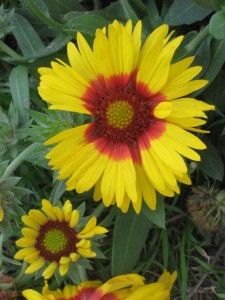
In actuality, it’s Nature’s Sequence, Fibonacci was just the Italian mathematician that first recognized it and put it down on paper. Here are a set of numbers that begin the sequence – 0, 1, 1, 2, 3, 5, 8, 13, 21, 34, 55 … x. Can you figure out the value of x? If you look at the sequence of numbers, you’ll see that after the first two numbers, the rest in the sequence are the sum of the previous two. Following this rule, x would be equal to 89. This sequence occurs all over nature. From the spirals on a Nautilus shell to the petals on a flower. Have you ever wondered why you’ve never seen a four leaf clover? Or a four leaf anything? Did you notice 4 isn’t in the FS? If you look carefully at a sunflower you’ll notice that the number of seeds in each circle follows the FS. So do the number of petals on flowers. So do a lot of things in nature. Check it out and see how many you notice.
So what does this have to do with your knitting? Well, if you’re doing stripes and you follow the FS, you’re sure to have a very good looking piece – guaranteed! As long as you’ve picked a good mix of colors that is. That’s just the way nature works. There’s nothing ugly out there! I know that a lot of women avoid horizontal stripes because they’ve been told that they are not flattering. Well, when you follow the FS, even horizontal stripes can look good. Don’t believe me? Here’s a link to Deborah Cook’s blog where she has posted a pattern for a Fibonacci Scarf. Just click on the picture to go to the page.
Have fun with this and we’ll continue this color journey soon …
Hugzzz 😎