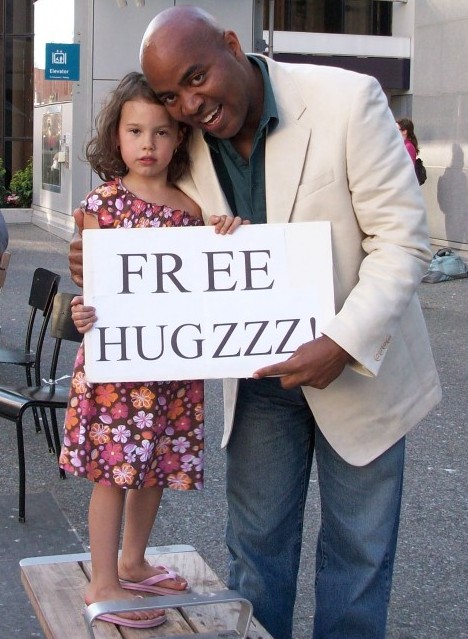
Before I get into Tuesday’s tips, I would like to thank everybody who helped out with the Hugzzz campaign on Sunday. It was truly awesome here in Vancouver. If you did one in your city, please send in some photos or just a brief note as to how it went. Ours started out with 2 people and had two others join in giving hugzzz. Surprisingly, I would say that 40% of the hugzzz were from men! It was such a success in fact that I will do one every month, just because. What did you do for Christmas in July? I’d really like to know, whether it was doing the hugzzz or just being extra nice to someone. Here is a picture of a truly adorable 5 year old girl that came up for a hug on Sunday. She gave a great hug too! Thanks Isabelle and all of the huggers!
Now onto the tips for this week.
Cast on an extra stitch – when you’re knitting in the round. On the first round, decrease it with your first cast on stitch (usually the slip knot). This helps eliminate the slack that is sometimes present at the beginnings of rounds in circular knitting.
Knot it – Ever get half way across your first row of stitches and notice that you’re out of yarn? You’ve been knitting with the leftover yarn from your estimate when you did the long tail cast on technique. When I finish the cast on stitches and have extra yarn dangling, I loop it up and tie a bow in it so as not to accidentally use it.It also keeps it out of the way and I can always tell my right side row by looking at where it it. If it’s on the left as I start to knit, I’m on a right side row! That’s 3 benefits from 1 tip – how cool is that?!
No need to knot – In the previous tip I said to knot, but for this one, you don’t need to.The one question I get from beginners is whether or not they need to knot their ends when they weave it in. Personally, I never do – knots have a way of making their way to the front of the work and making an appearance. I use a back and forth method to weave in ends so as to make it almost impossible for them to work their loose. If I am using a slippery yarn such as rayon, I will sew down the end with a similar color thread.
Size it up – In trying to decide on the right size for a project, I try and find a similar garment I have that fits me comfortably. When I do , I take the measurements from that to determine the correct size for me (or whoever I’m making the project for). I also try and match the materials (fiber) when possible as this gives me a better idea of the drape.
Rhyme it– When learning anything a rhyme often makes it easier. Here are two for the knit and purl stitch that date way back but are still good today …
Knit – Purl
In through the front door Under the fence
Around the back Catch the sheep
Out through the window Back we come
And off jumps jack. Then off we leap.
Cable crazy – When you’re first learning cables it might get confusing as to when it goes left and when it goes right. It’s actually not so bad if you remember that a R or right cable always has you holding the cable needle to the back and a L or left cable has it held to the front. Next time you can look at the instruction and not have to check the glossary to remember where to hold your cable needle.
Those are our tips for this week. Tomorrow we’re going to start a lace project!
Hugzzz 😎